
1849
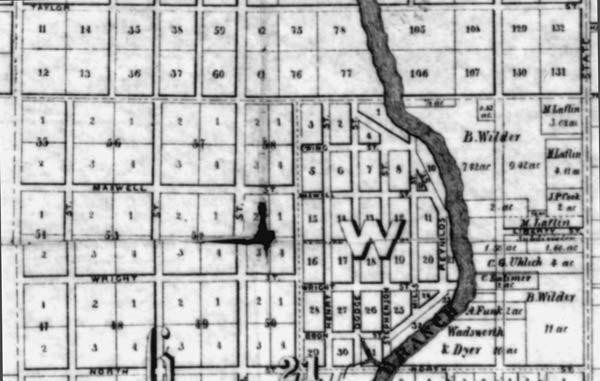
When the city of Chicago incorporated in 1837, its geographic boundaries included the area on which Maxwell Street was later platted. By 1849, Maxwell Street is shown on a map extending west from the South Branch of the Chicago River to Halsted Street.
1853
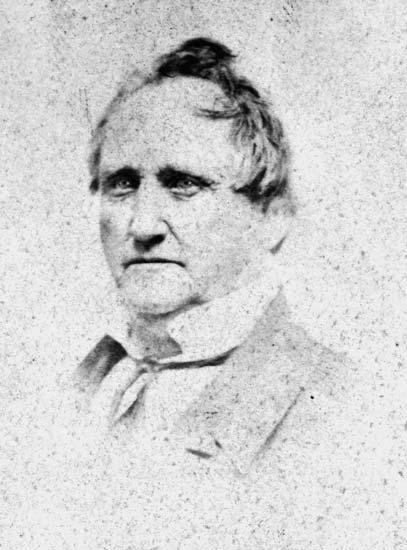
Dr. Philip Maxwell, for whom Maxwell Street is named, served in the military, held the title of city physician, was a state legislator, and a notable Chicgao citizen. In the 1840s, a Maxwell Street was named for him in Chicago, and also in Lake Geneva, WI where he put up money to plat the “Big Foot” settlement that later became the Village of Lake Geneva. This photo of Dr. Maxwell is believed to be c. 1853, before he moved from Chicago to his retirement home at Lake Geneva where he died in 1859.
1855
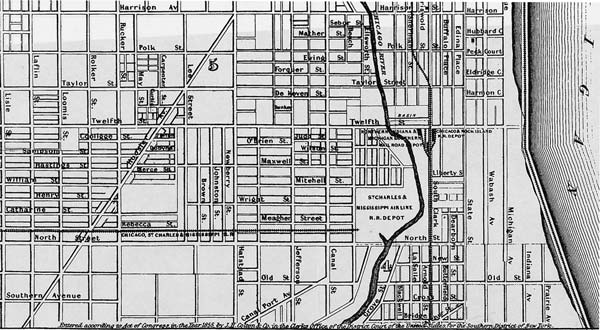
The opening of the I&M Canal that bridged the Chicago and Illinois Rivers brought activity to the numerous streets intersecting the south branch. By 1855, Chicago’s first railroad had entered the city, and Maxwell Street is shown originating at the river extending to Blue Island Avenue. The new arrivals to Chicago created the need for quickly-built housing in the nearby Maxwell Street area for Irish, German and Bohemian immigrants.
1857
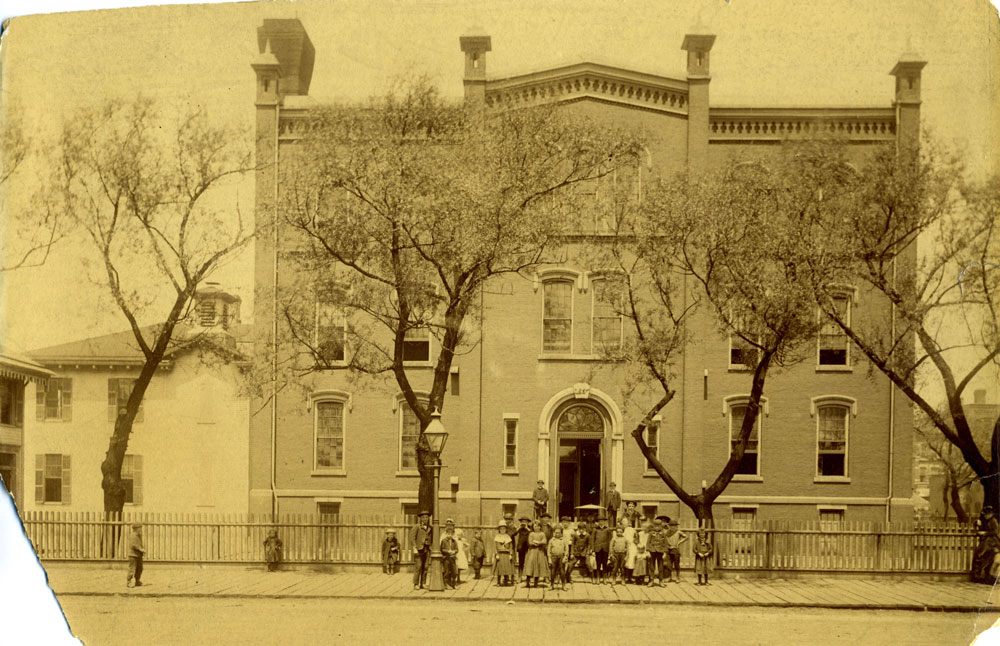
Foster School is built two blocks north of Maxwell Street on O’Brien Street at Union Avenue. Foster School was Chicago’s ninth permanent public school building built by the Chicago Board of Education, named for Dr. John H. Foster who was a member and later president of the city’s first Board of Education. Known also as “School No. 9”, the building remained an elementary school until 1960 for the Maxwell Street neighborhood, and then served as a training academy for the Chicago Police Department until 1975.
1860
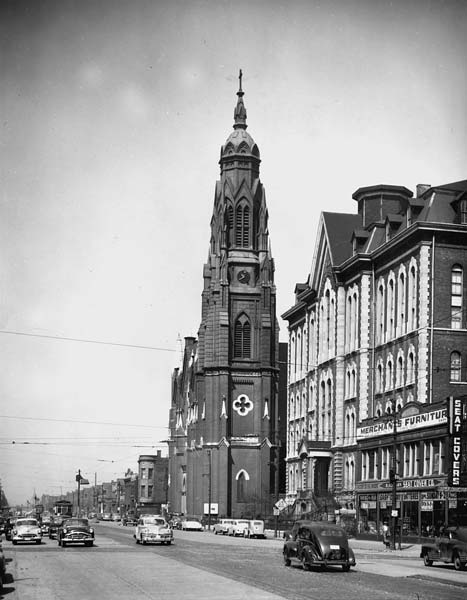
Hallmarks of immigration and migration are effectively shown by cultural buildings erected such as the early churches in the Maxwell Street neighborhood. Holy Family church was dedicated in 1860, founded by Reverend Arnold Damen (for whom Damen Avenue is named), and was the original Jesuit Parish in Chicago. It originally served an Irish congregation, then German, Italian, African American, and Mexican American, following the national waves of newcomers. Holy Family Church is also the mother institution of St. Ignatius College (St. Ignatius College Prep today) erected immediately east of the church in 1870. Street addresses begin to appear in city directories on Maxwell Street as evidence of an early residential population.
1861
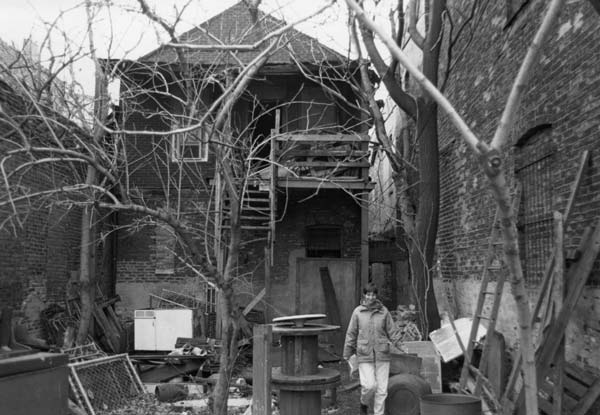
The lumber used to construct many one- and two-story wood frame cottages on Maxwell Street had evidence of both vertical and circular sawn lumber, showing the advance of the circular saw during the Civil War (1861-1865). This one-story wood frame cottage, shown from the rear, was later hoisted onto a brick foundation and given a new brick facade on Maxwell Street, disgusing its early roots on Maxwell Street to the average passer-by.
1864
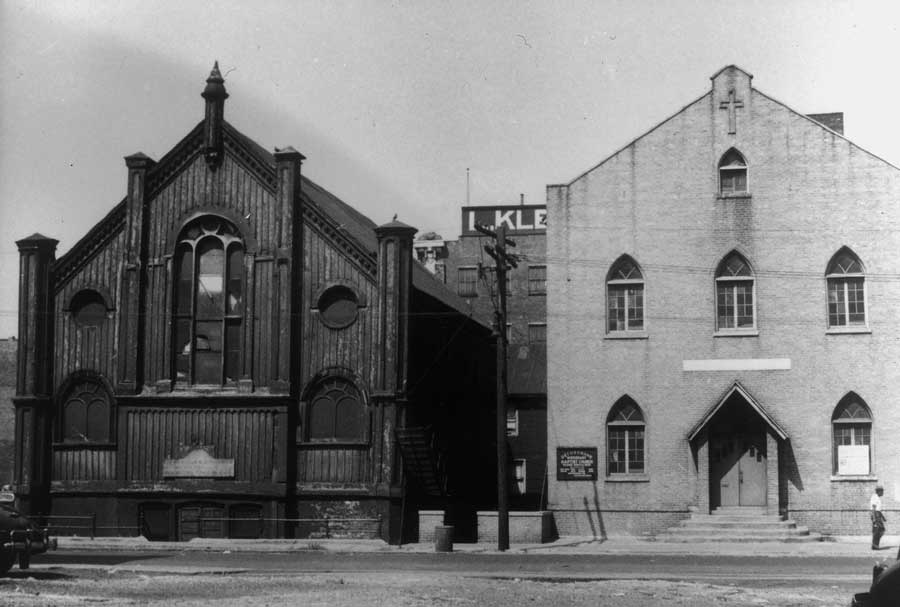
Germans, a dominant immigrant group to Chicago in the mid-19th century, built this Evangelical Church (left) in 1864, whose congregation then built a school for their German-speaking children (right) in 1869 (the latter is shown following the replacement of its facade in 1944). Both buildings stood two blocks south of Maxwell Street at Union Ave and 14th Street. Augustus Bauer, a German immigrant considered to be Chicago’s first professionally trained architect, designed both these 19th century structures and the latter survived into the 21st century.
1864
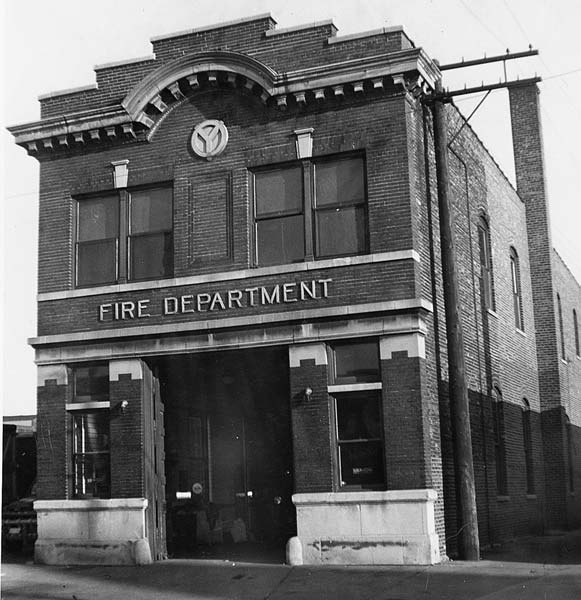
The Chicago Fire Department, organized in 1858, operated a firehouse on Maxwell Street as early as 1864 identified as “Engine 6”. Its steamer engine, “Little Giant”, was the first to arrive at the scene of the 1871 Great Chicago Fire. Maxwell Street’s last firehouse is shown here, and was the last built in the city for the horse-drawn engine.
1869
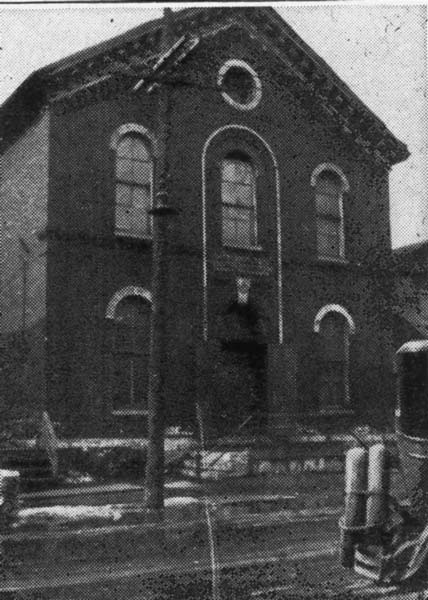
The term “windows with eyebrows” characterized a design style brought to the U.S. by the German immigrant architects that was employed throughout midwest towns and cities. Formally known as Rundbogenstil influenced design, the original facade of the 1869 German Schoolhouse clearly expresses the German details and the German immigrant settlement of the Maxwell Street neighborhood at that time.
1871
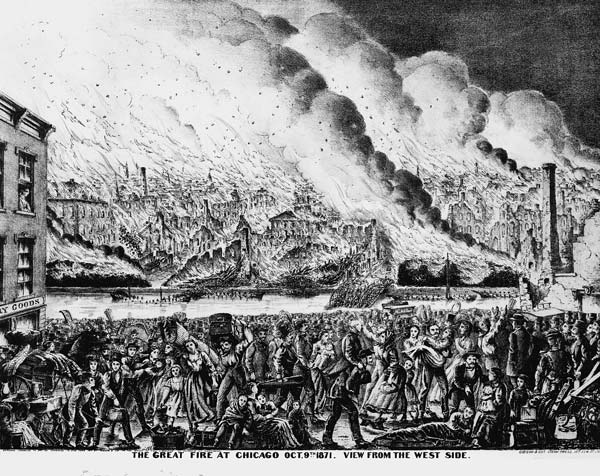
Refugees fled to the west side of the Chicago River during the Great Fire, which left 100,000 people homeless. The fire started near the Maxwell Street neighborhood, but swept northeast, largely sparing the neighborhood so that it became heavily populated after the fire.
1872
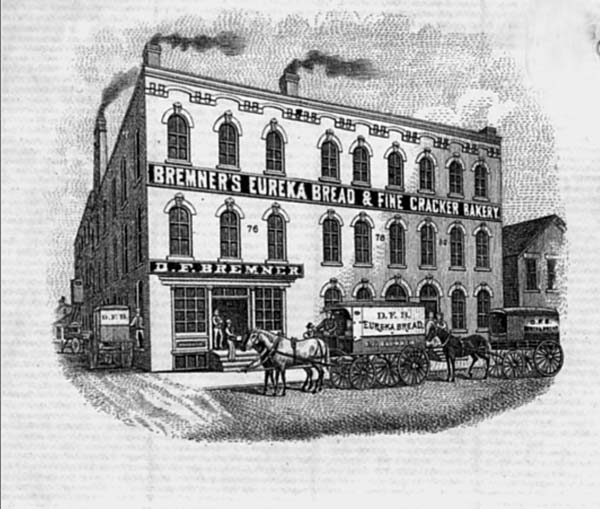
Many businesses fled to the Maxwell Street neighborhood that remained unscathed from the 1871 fire because it was south and west of the origin of the raging fire, which burned north and east. David Bremer moved his bakery to O’Brien Street two blocks north of Maxwell Street in 1872, and by 1899 became a member of the National Biscuit Company (NABISCO) that expanded his business operations onto Maxwell Street.
1875
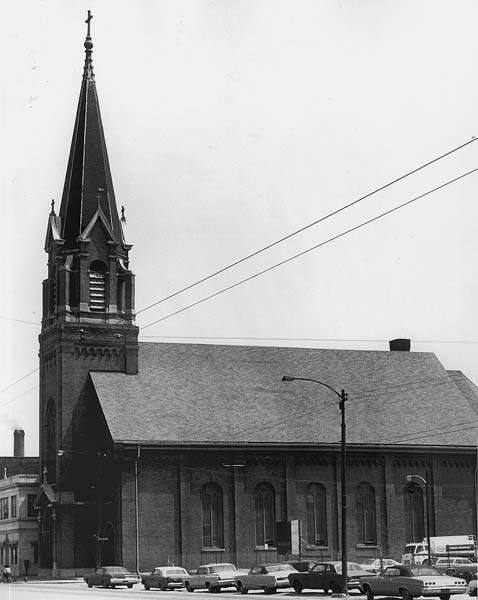
St. Francis of Assisi Church was built by the German population that inhabited the early Maxwell Street neighborhood in 1875, and when it burned in 1904, they constructed a second church on the site that they only habited for four years before leaving the neighborhood. The new church retained the original apse of the 1875 structure. The church then began to be used by Mexican immigrant and Mexican American populations and continues to serve them today.
1877
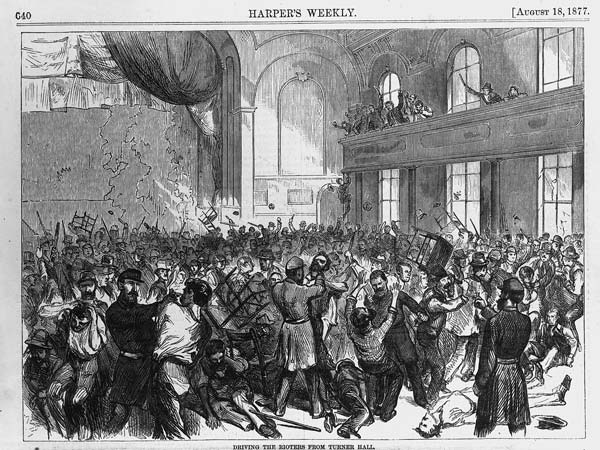
The Chicago German Furniture Workers Union was meeting with management in the West Side Turner Hall on July 26, 1877 at 12th (now Roosevelt Road) and Union Streets. With workers mobilizing as the national railroad strike raged, the Illinois National Guard attacked workers inside, and Chicago Police assaulted the workers inside, injuring many and killing one man. This depiction by Harper’s Weekly is an anti-labor portrayal, characterizing workers as “roughs who never did an honest day’s work” and “the lowest class of Poles and Bohemians.”
1880
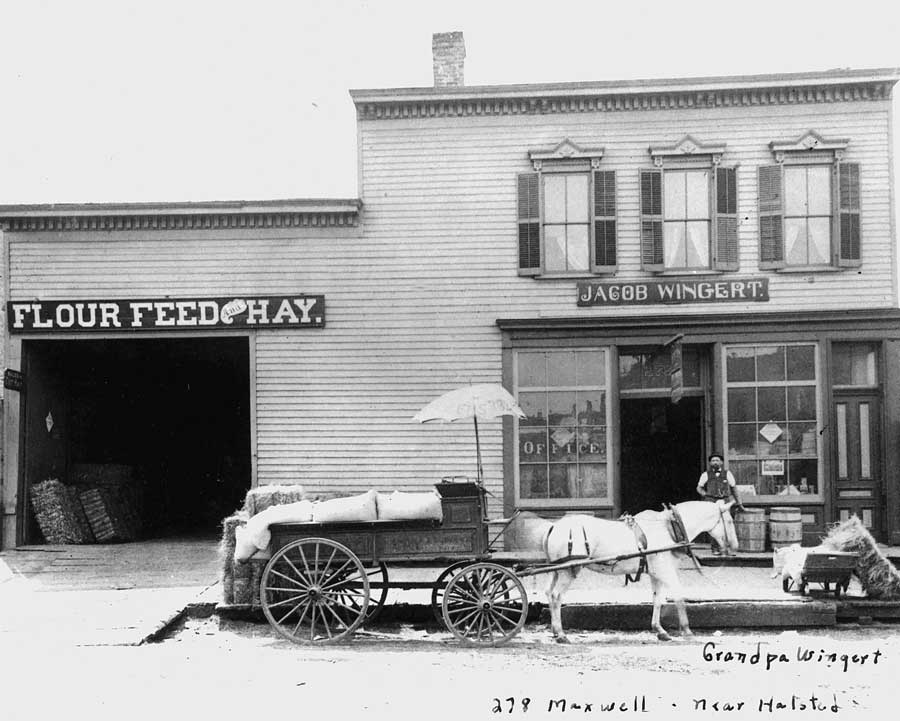
Jacob Wingert, an early merchant on Maxwell Street, lived above his flour and feed store and set a precedent in the 1880s for the mixed retail and residential use that characterized Maxwell Street until the end of the 20th century. Jewish immigrants fleeing pogroms in Eastern Europe flooded the Maxwell Street area, and became the largest and longest standing population on Maxwell Street.
1883
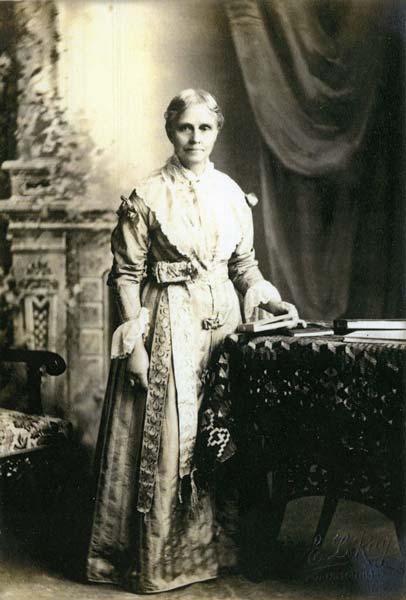
The Bohemian Mission is established on Maxwell Street by Elizabeth Marcy with five other women in the The Woman’s Home Missionary Society.
1888
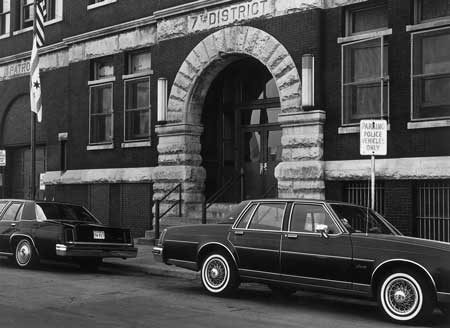
The 7th District Police Station was built on Maxwell Street in response to the need for increased police presence in the district that became known as “Bloody Maxwell”. Violence raged between a changing melting pot of rival gangs of Irish, German, Italian and European Jewish immigrants. This police station was the longest in operation in the city of Chicago when the University of Illinois at Chicago acquired it and then placed it on the National Register of Historic Places in 1996 for campus police operations. In the 1980s, the exterior of the building was the fictional police station in the 1980s television show, “Hill Street Blues”.
1891
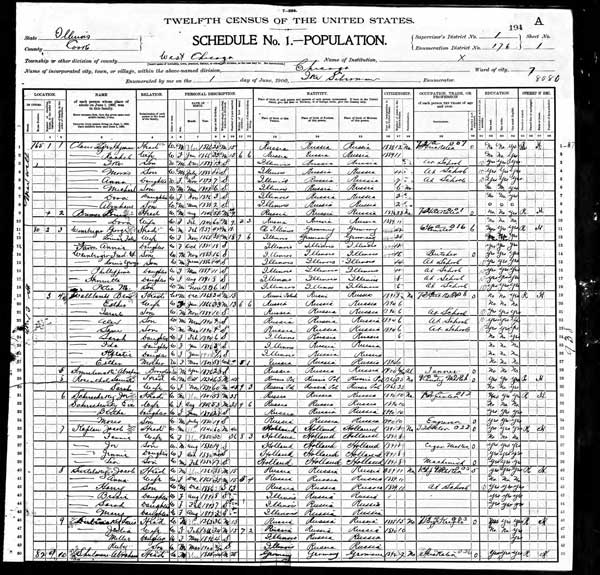
A city survey shows 16,000 people living on a one-mile stretch of Maxwell Street. This is further evidenced by the 1900 census showing page after page of large families and often numerous borders living at single street numbers on Maxwell Street.
1893
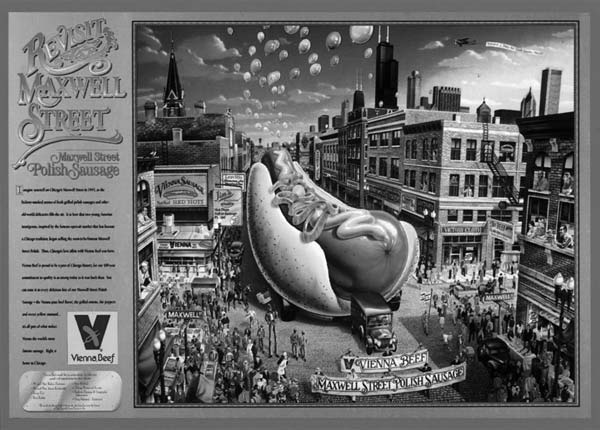
After introducing their sausage at Chicago’s Columbian Exposition, Samuel Ladany and Emil Reichel, immigrants from Austria-Hungary, open a sausage shop on Halsted Street two and one-half blocks north of Maxwell Street that became the major manufacturing company Vienna Beef.
1895
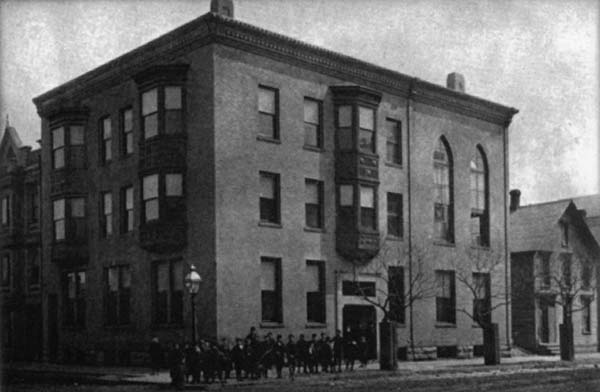
Marcy Center is established on Newberry Street at Maxwell Street to offer medical services to thousands of impoverished families. Its original facility was replaced by this three-story building one year later.
1895
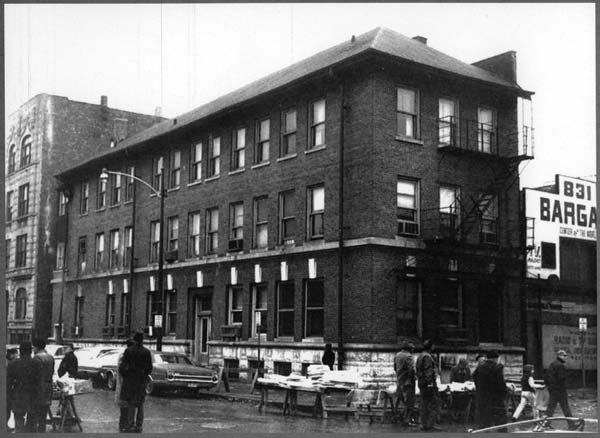
The Chicago Lying-in Hospital was founded in the Maxwell Street Dispensary at Maxwell and Newberry Streets, where one year later it moved across the street and became a training school for obstetrical nurses. In 1917, funds had been raised to erect this three-story building opposite the Marcy Center on Newberry Street, where it paved the way for modern obstetric care and was renamed the Chicago Maternity Center in 1931.
1897
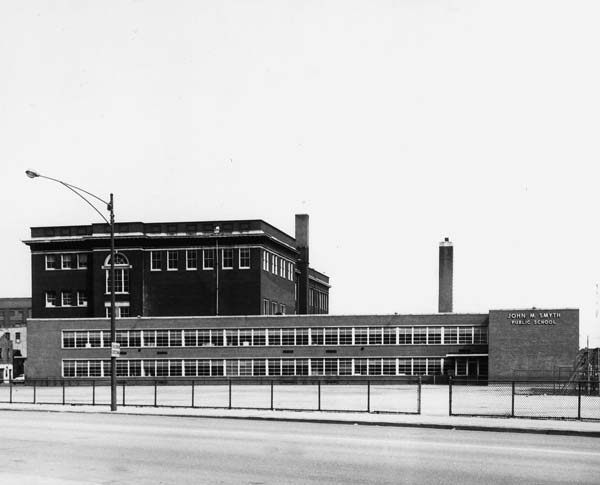
The John M. Smyth School is built on Maxwell Street (the original school had later additions). The grammar school ultimately inherited students from school closures in the Maxwell Street neighborhood during the early development of the Chicago Board of Education, and still operates today.
1903
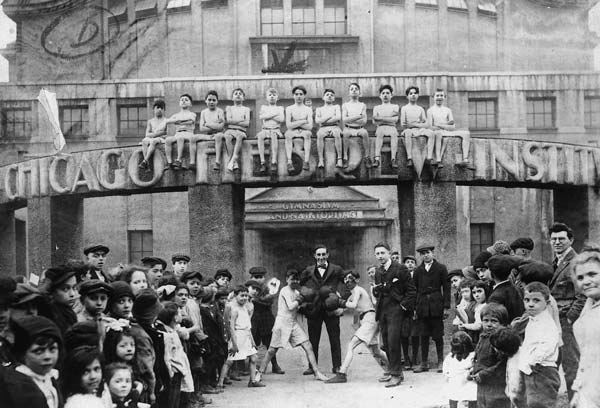
Chicago Hebrew Institute is established on Blue Island Avenue, north of its intersection with Maxwell Street. This social service organization was the forerunner of the Jewish Community Centers of Chicago. The Jewish population was the largest and longest-standing in the Maxwell Street area, and they were its predominant residents and merchants when the street later became an open-air market.
1903
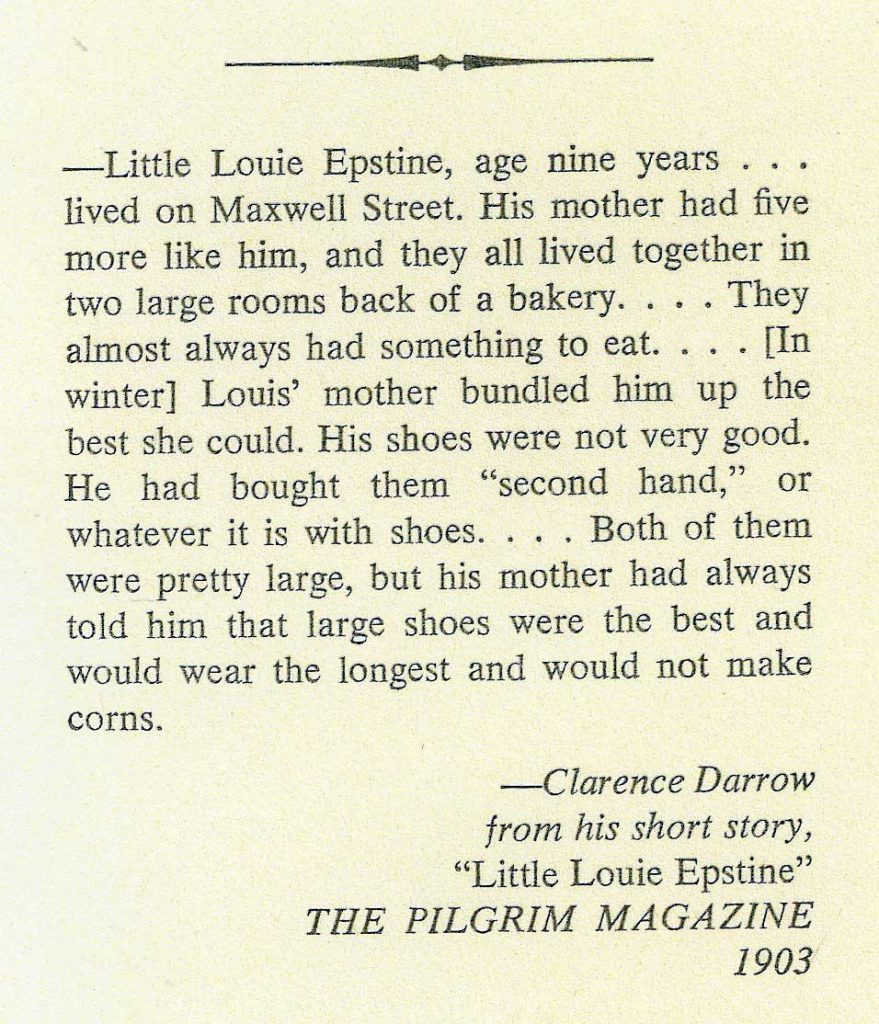
Clarence Darrow’s short story about “Little Louie Epstine” who lived on Maxwell Street was published in the Pilgrim Magazine.
1905
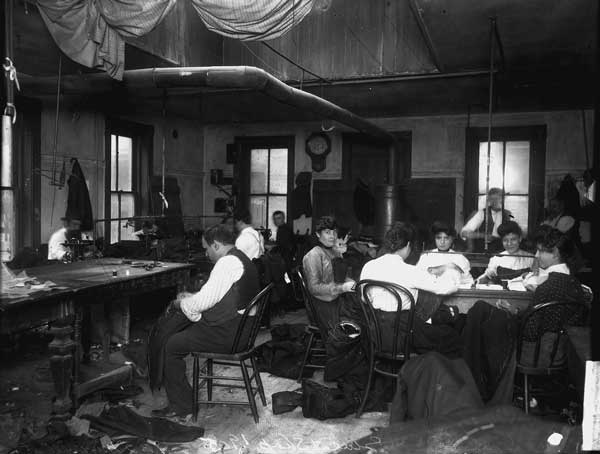
Sweatshops and tailor shops become prevalent along Maxwell Street where immigrant residents provided cheap labor and needed skills. Tailor shops remained in business on Maxwell and Halsted Streets into the 21st century.
1910
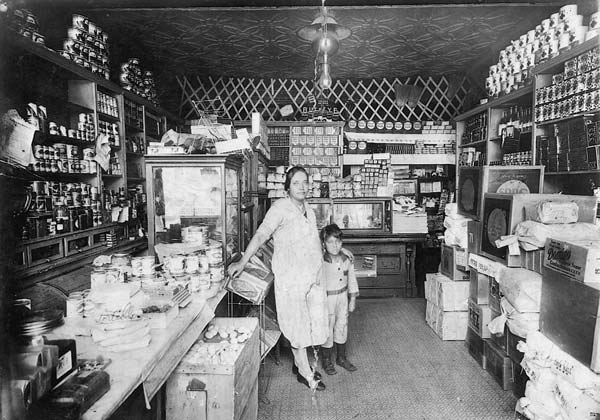
Mexicans fleeing the Mexican Revolution in the 1910s came north to fill a shortage of workers due to WWI, taking work in steel mills, factories, and railroads. Here a woman and her son in her grocery store “El Gardenia” at 1100 S. Peoria Street, 1921.
1912
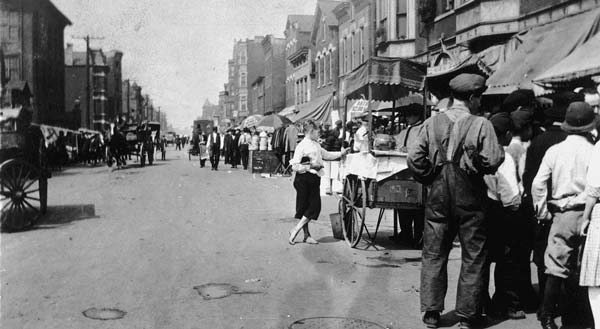
In 1912, the city of Chicago passed an ordinance that created a public market on Maxwell Street from curbside at Jefferson Street to curbside at Halsted Street, “…set apart for market purposes on each and every day of the week…”. The ordinance also established the office of a superintendent to oversee the Maxwell Street Market. This view of the early Market is looking west from Jefferson Street.
1912
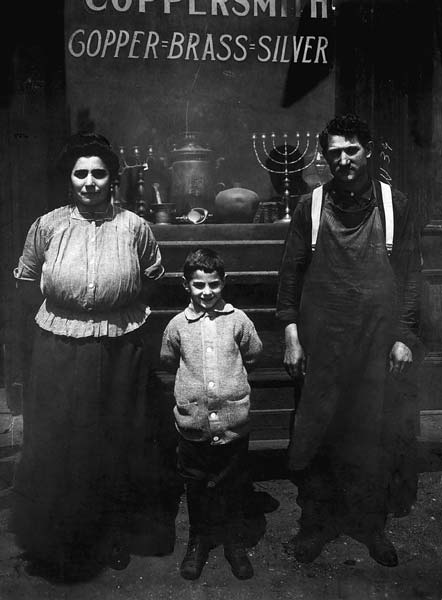
Jewish immigrants from Russia and Eastern Europe settled in the Maxwell Street area as self-employed peddlers or shopkeepers. This family’s coppersmith shop was on West 12th Street (Roosevelt Road).
1916
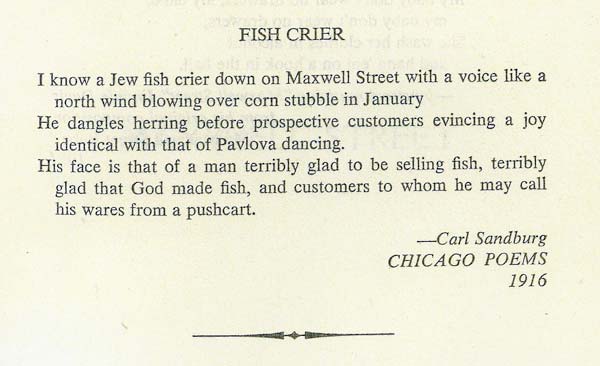
The Maxwell Street Market is extended by city ordinance to Sangamon Street, and the “Fish Crier” poem by Carl Sandburg is published in Chicago Poems.
1920
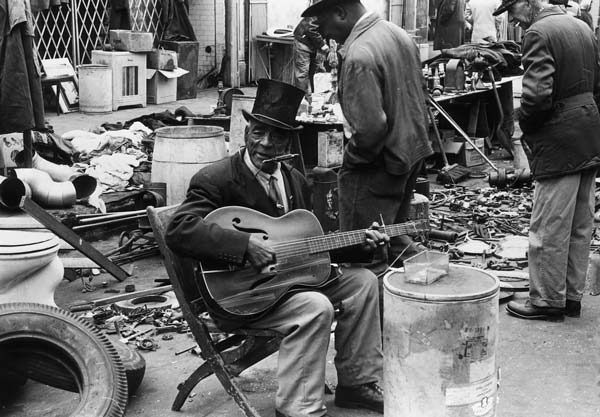
Johnny “Daddy Stovepipe” Watson discovers the ready-made audience for his performance of Christian music as a street musician at the Maxwell Street Market. Born in 1867, he was one of the oldest blues musicians to record commercially in the 1920s. He recorded music with his wife “Mississippie Sarah” as well. He was a regular at the market as a one man bad until his death in 1963.
1925
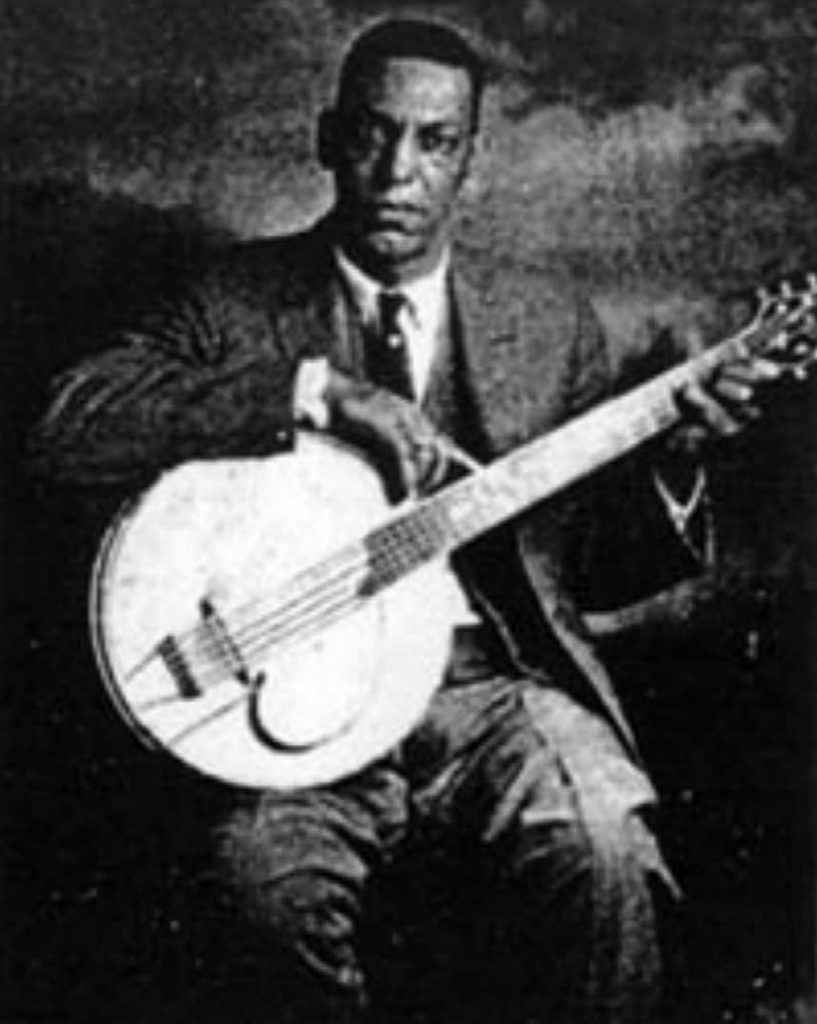
Paramount Records releases “Papa” Charlie Jackson’s “Maxwell Street Blues” where he found a ready-made audience for his banjo performances at the Market.
1926
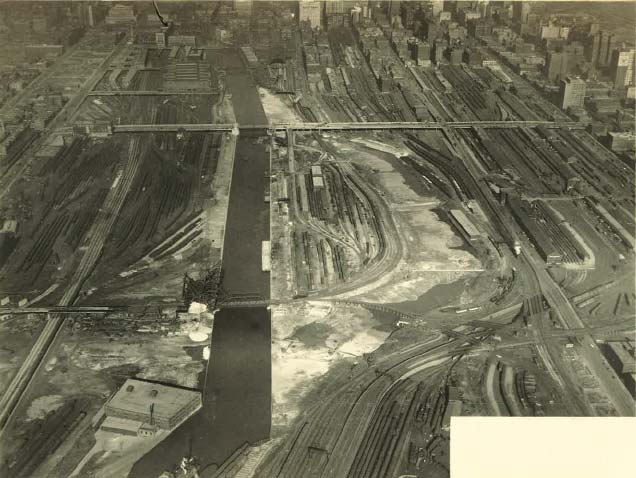
A project begins to straighten the severe bend in the South Branch of the Chicago River, where Maxwell Street had originally extended.
1929
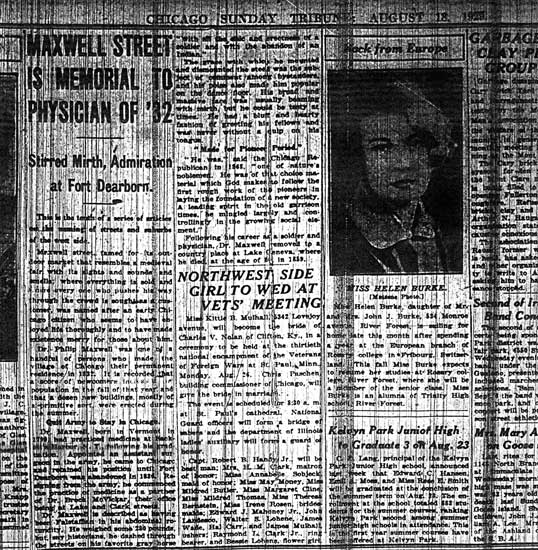
Dr. Philip Maxwell is recognized for the name of the Maxwell Street Market in a Chicago Tribune article dated August 18, 1929
1930
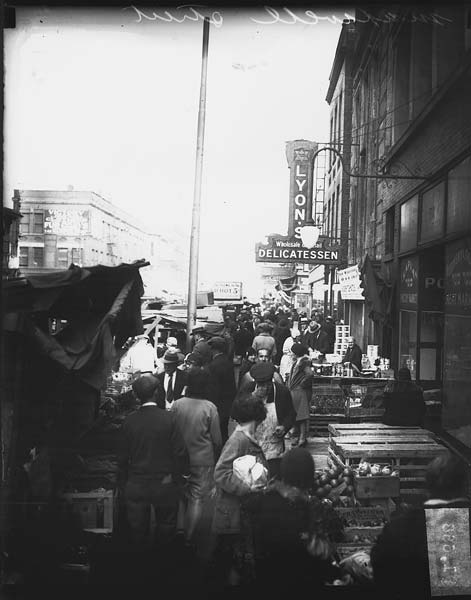
Known for its kosher corned beef, Lyon’s Delicatessen operated from the 1930s through the 1960s. “Mama” Sarah Lyons continued to provide gefilte fish and pickled herring for her son who took over the business. They sold the business to their long-time employee, Nate Duncan, an African American who learned Yiddish and kept the kosher menu when he renamed it Nate’s Deli in 1972.
1932
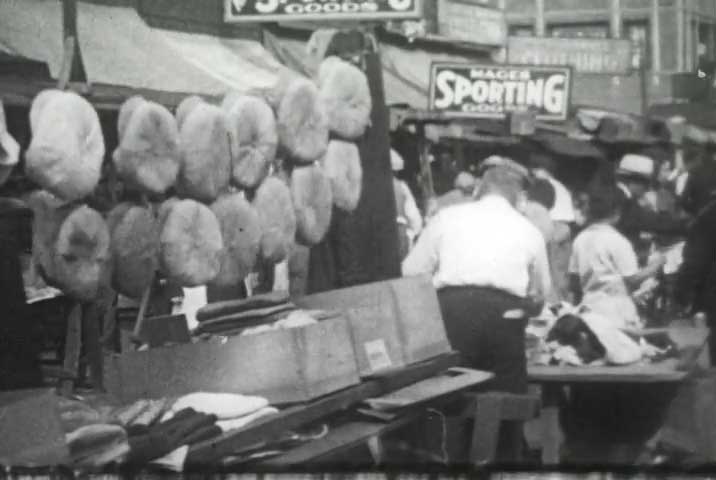
Carl Friberg’s film “Halsted Street” documents the length of Halsted Street in Chicago, and intersects the Maxwell Street Market in rare film footage.
1938
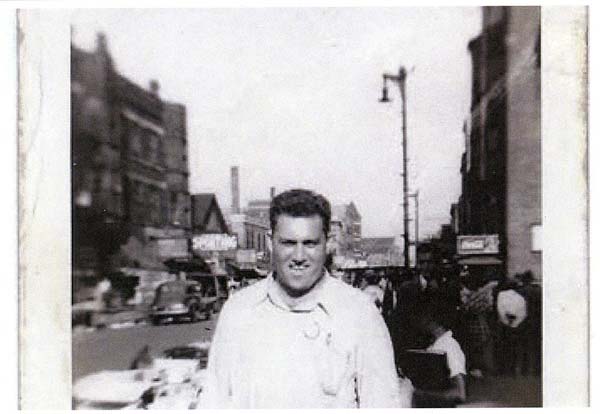
Bernard Abrams owned a record and radio shop at 831 W. Maxwell Street and allowed Blues musicians to plug into his store, and later established a recording studio in the back of his store, producing his own music label. At Maxwell Street, these musicians from the rural south mixed with other Blues musicians who amplified their sound by plugging into electricity provided by the continuous line of shops along Maxwell Street. The amplified sound of the Delta Blues from the rural south amplified birthed the sound we know as the Chicago Blues.
1939
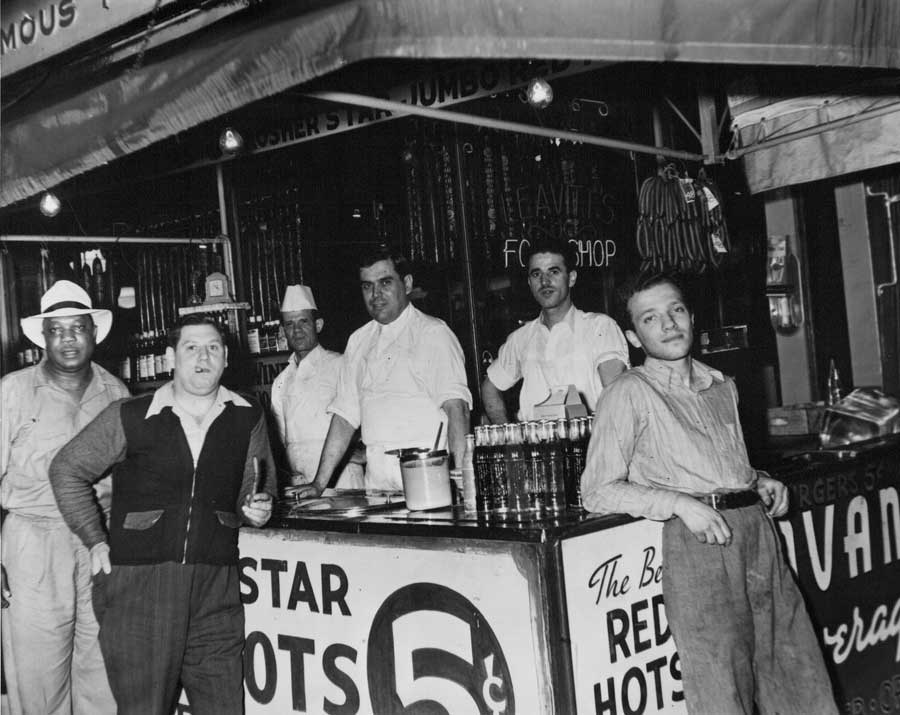
Jim’s Original, at the heart of the Market for decades, was begun by “Jimmy” Stefanovic, a Roumanian immigrant, who started the business at a street stand in 1939. In 2001, the business had to move to Union and O’Brien Streets where it continues to serve Vienna red hots, pork chop sandwiches, and Maxwell Street Polish sausages with sweet grilled onions 24 hours a day, 360 days of the year.
1939
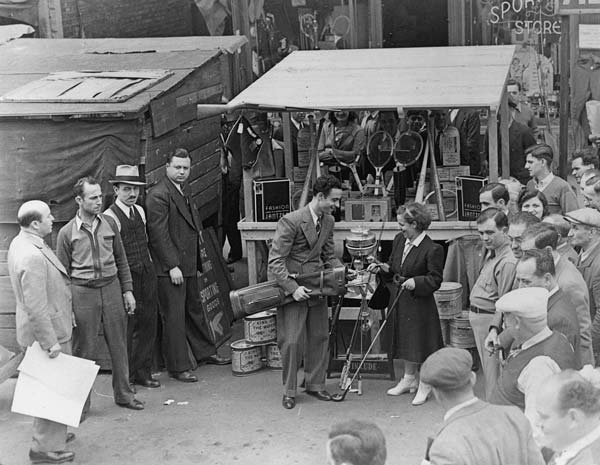
The Maxwell Street Merchants Association (MSMA) conducts the Maxwell Street Civic Improvement Project to standardize and improve the appearance of Maxwell Street. Here a model stand in front of Kaye’s Sports Goods at 716 W. Maxwell is unveiled.
1940
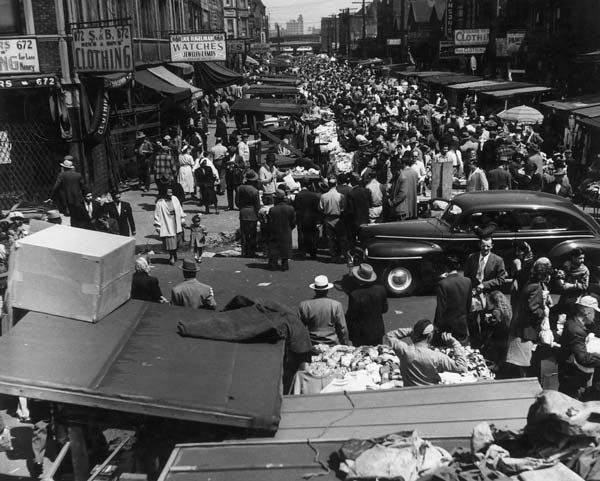
Maxwell Street, although it always remained open to vehicular traffic, attracted dense pedestrian traffic on Sundays throughout the year.
1940
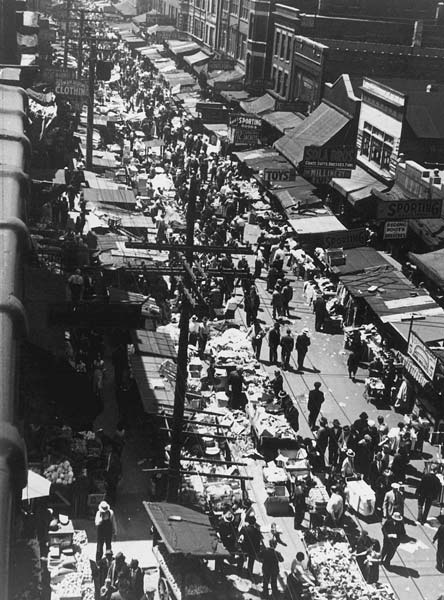
The view from above shows the three-tiered marketing strategy developed on Maxwell Street where shoppers funneled by sidewalk storefronts, curbside sheds, and vendor tables open to the street
1947
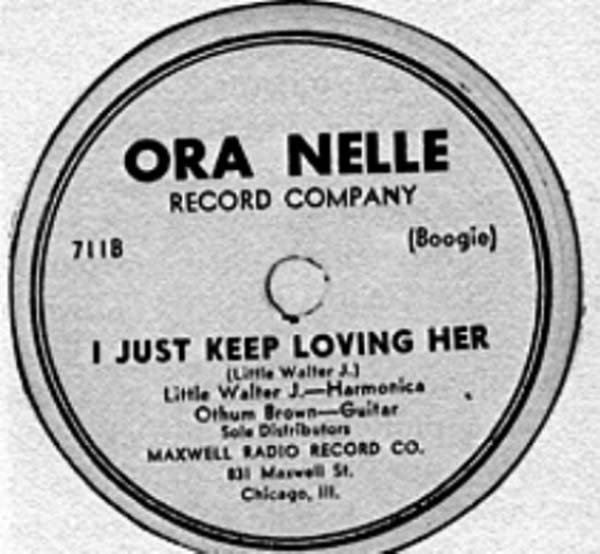
Little Walter Jacobs performed on Maxwell Street in the 1940s, and was recorded by Bernard Abrams in a first release of the Ora Nelle Record Co. label, the only record company based on Maxwell Street, releasing Little Water Jacobs first record in 1947.
1951
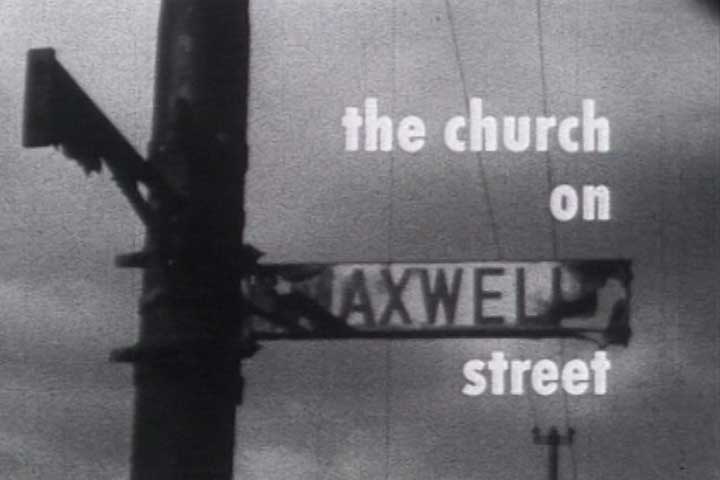
Artists Marvin E. Newman and Yasuhiro Ishimoto release their film, “Church on Maxwell Street” of compelling gospel music on Maxwell Street. (RT 7 minutes.)
1952
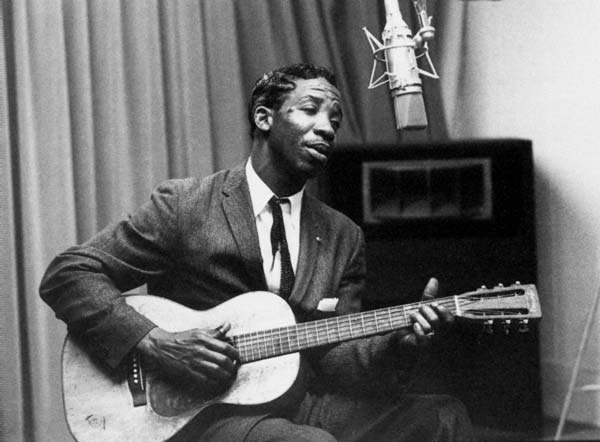
Maxwell Street Jimmy Davis performed blues music on Maxwell Street from the 1950s through the 1970s, while operating the Knotty Pine Grill on Maxwell Street.
1952
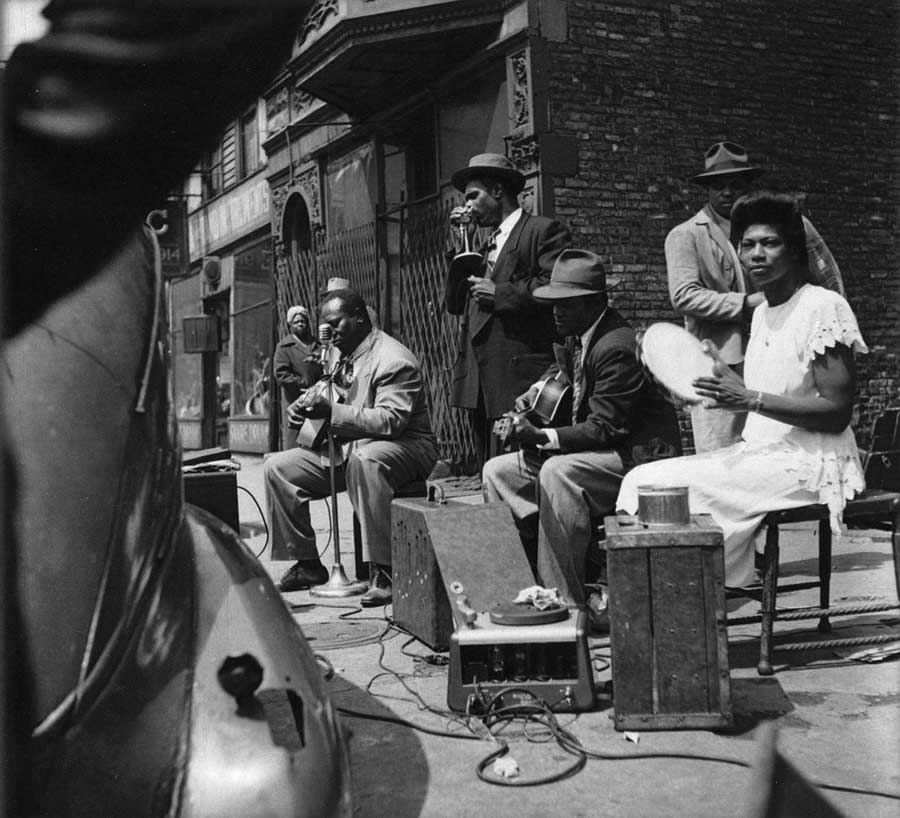
Gospel music also thrived at the Sunday Maxwell Street Market.
1954
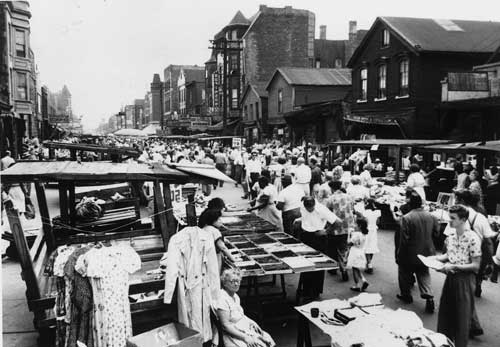
Edward C. Schulz submits his master’s thesis entitled, “A Functional Analysis of Retail Trade in the Maxwell Street Market Area of Chicago” to the Geography Department at Northwestern University, that is a first scholarly work on the Maxwell Street Market.
1955
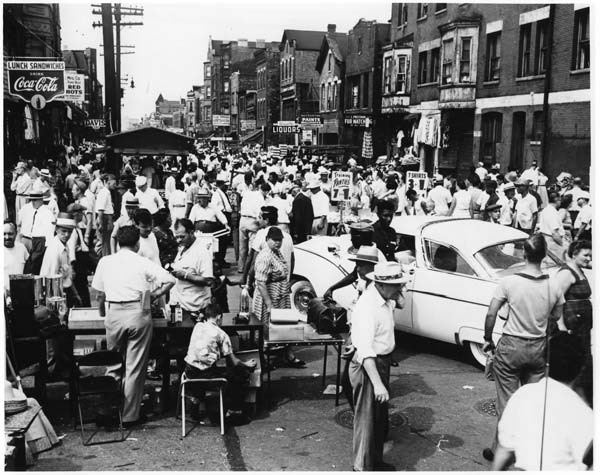
The Maxwell Street Market continues to flourish from its origin at Jefferson Street, westward.
1957
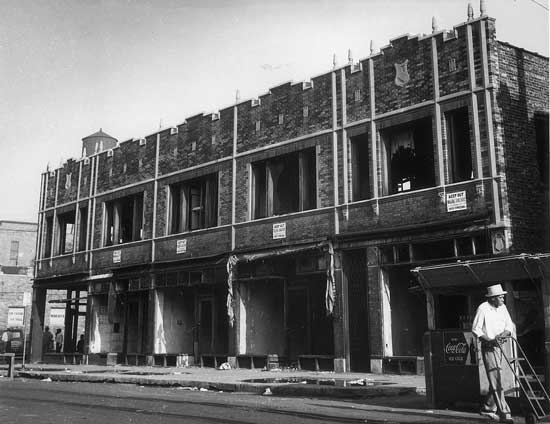
Buildings on Maxwell Street Market east of Union Ave. were prepared for demolition for the planned construction of the Dan Ryan expressway.
1959
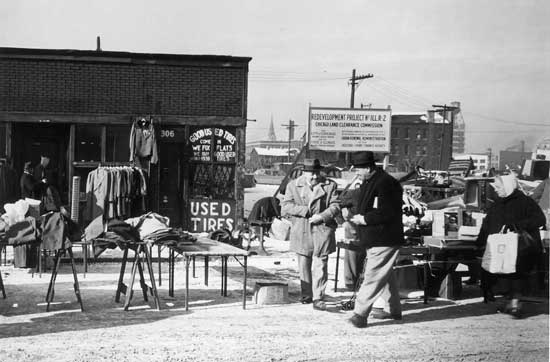
Chicago Land Clearance Commission clears the rest of properties in the Maxwell Street Market vicinity east of Union Ave., in preparation for the construction of the Dan Ryan expressway.
1961
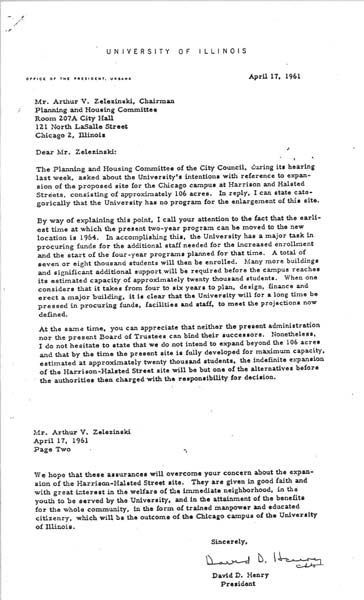
Letter from the President of the University of Illinois responds to a local citizen’s concern about the university’s intentions to expand the planned Chicago campus at the Harrison-Halsted site, in the future.
1964
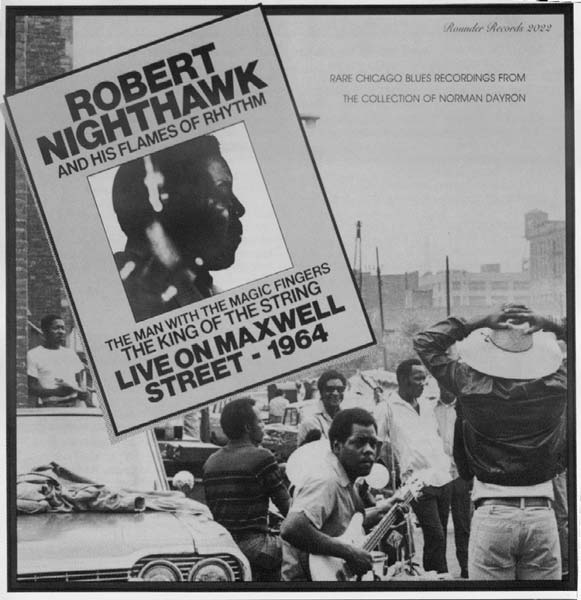
Robert Nighthawk’s album “Live on Maxwell Street – 1964” is recorded, and later released by Rounder Records.
1965
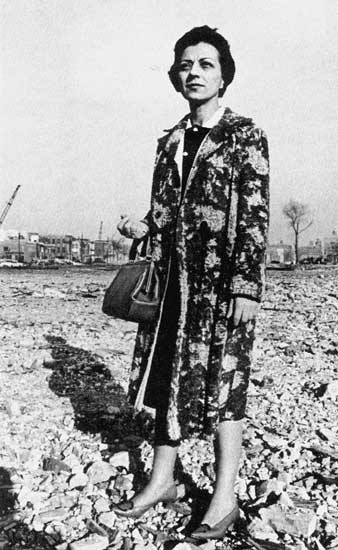
In 1965, the University of Illinois at Chicago opened, championed by Mayor Richard J. Daley. The site at Harrison and Halsted Streets displaced 14,000 residents and 800 businesses and was fought by community members like Florence Scala, from the Italian American community, who thought they were helping to plan a residential development.
1965
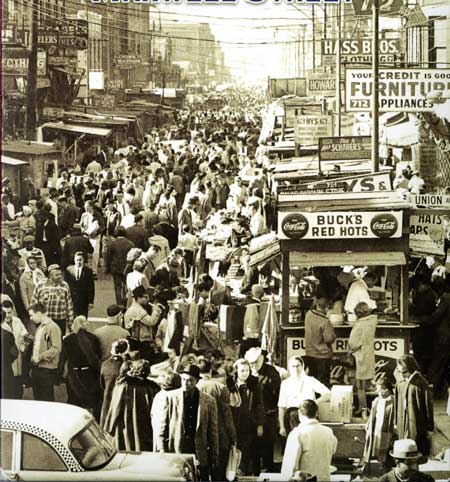
The epic film, “And This is Free” documenting Maxwell Street and the Market, is released. (RT 48 minutes.)
1965

The first Intergovernmental Agreement (IGA) by and Between the City of Chicago and the Board of Trustees of the University of Illinois is published.
1966
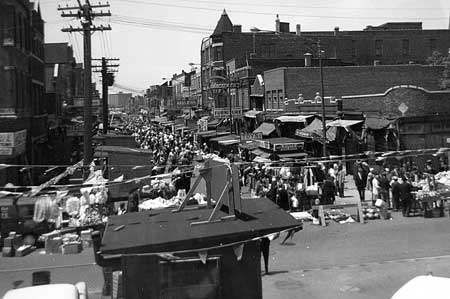
The construction of the Dan Ryan Expressway pushed the Maxwell Street Market west of Union Avenue, where the Market expanded on neighboring streets within new geographic boundaries .
1966
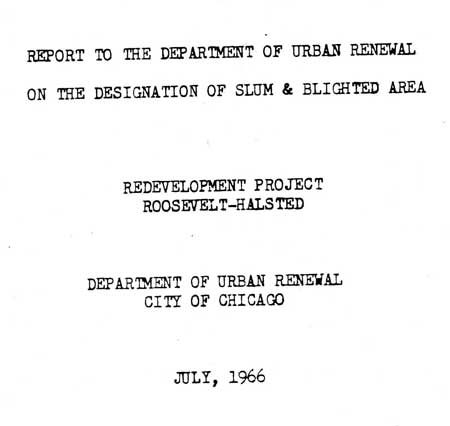
An Analysis of the Maxwell Street Market is prepared by the City of Chicago Department of Urban Renewal, and the area containing the Market is formally designated as slum and blighted by the Department of Urban Renewal.
1967
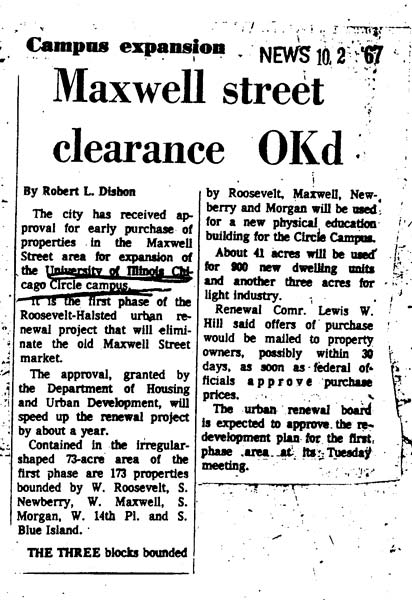
The city receives approval for early purchase of properties in the Maxwell Street area for the expansion of the University of Illinois Chicago Circle Campus, that includes the Maxwell Street Market within the 73-acre site.
1971
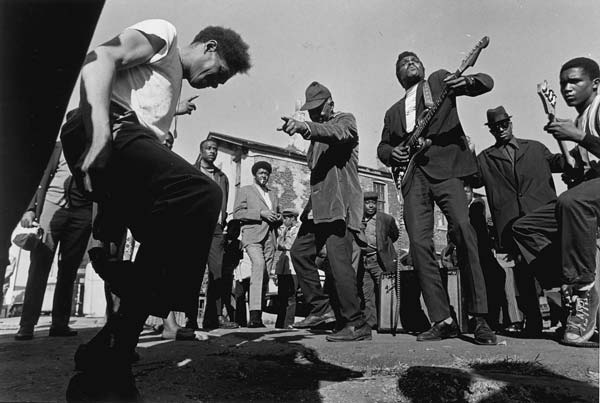
Musicians continue to perform for tips at the Market through the decades to appreciative crowds. L’il Pat plays here on Peoria Street between Maxwell & 14th Streets.
1977
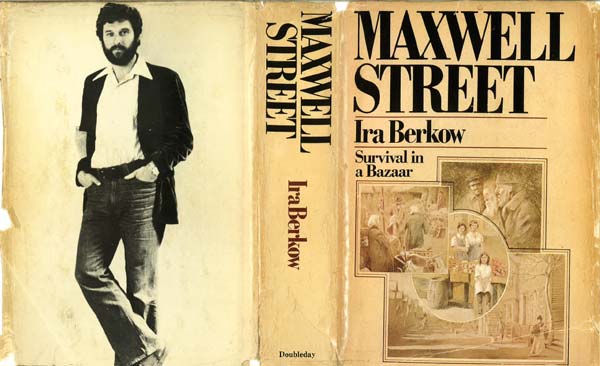
Maxwell Street: Survival in a Bazaar is published by Ira Berkow, and is comprised of interviews with 51 characters about Maxwell Street that chronicle the Market, and is a first published book about Maxwell Street.
1980
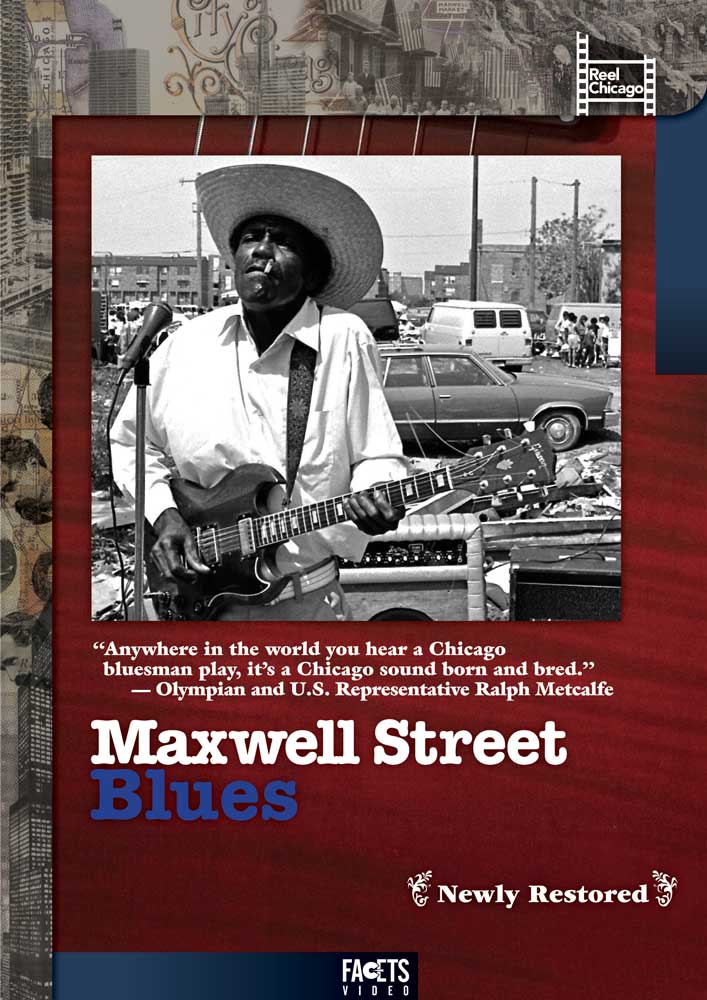
A documentary specifically about blues music on Maxwell Street is released (RT 56 minutes).
1982
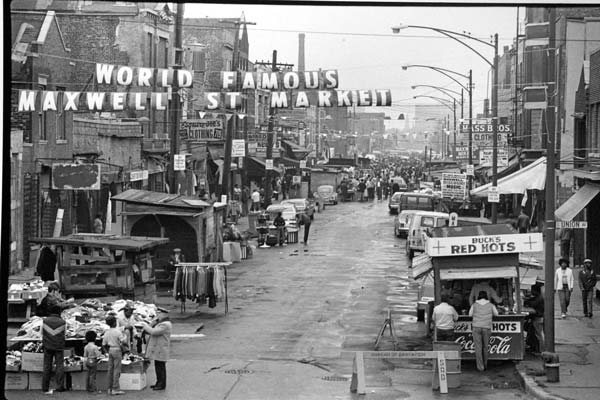
Maxwell Street retains its characteristic look, but city services to the street and for the Market decrease and begin to take its toll.
1983
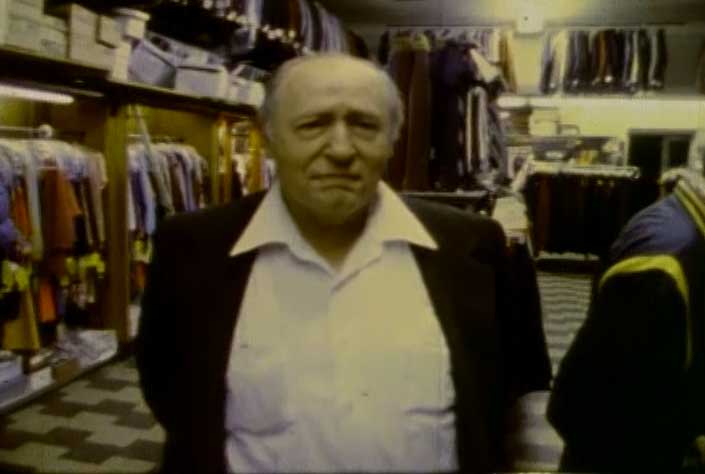
“Maxwell Street” is produced by Tom Palazzolo, interviewing merchants and shoppers at Maxwell Street. (RT: 36 minutes.)
1988
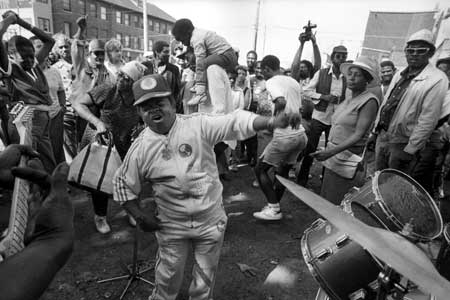
Blues music continued to be performed at the Sunday Market.
1988
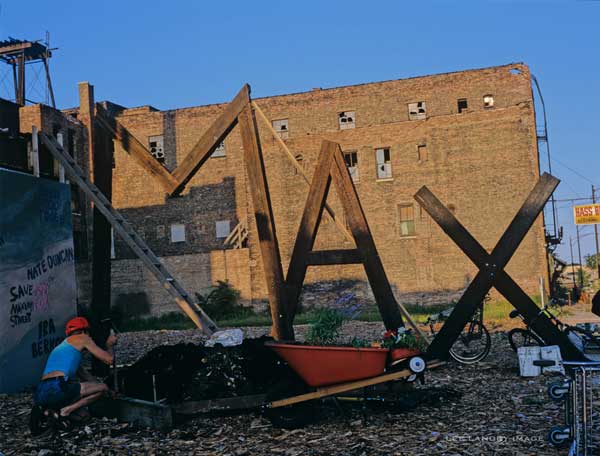
MAX sculpture and the Maxwell Street Wall of Fame is erected on the northeast corner of Maxwell and Halsted street by members of preservation and community groups, and Frank ‘Little Sonny’ Scott Jr.’s Juketown Community Blues Bandstand.
1989
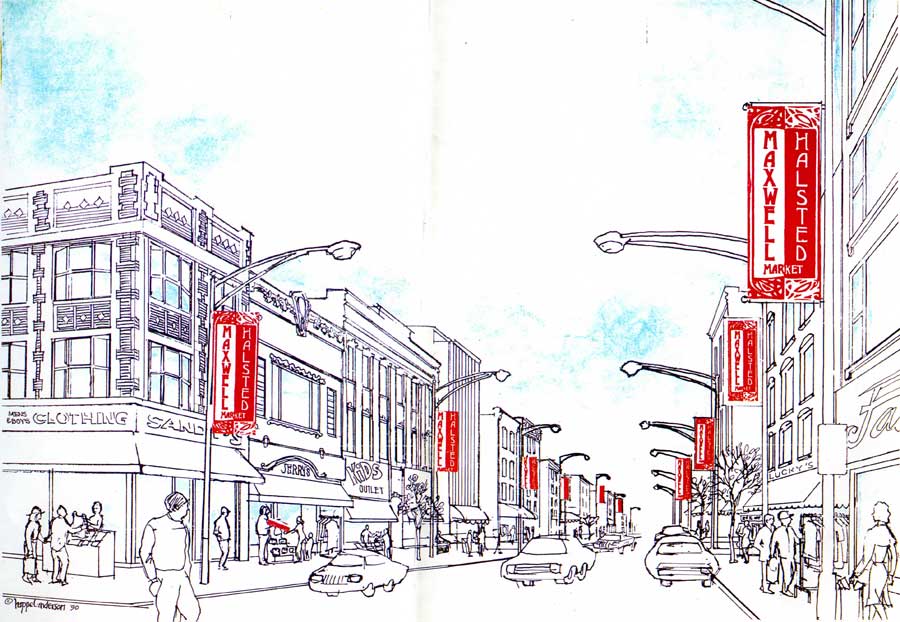
A Community Advisory Panel (CAP) is established by the Chicago Department of Planning that recommends “that the Department of Planning, the University of Illinois, and Maxwell Street Market area groups work together to come up with a plan to which all could agree.” Plans are drawn by a member of CAP proposing mutual use at Maxwell and Halsted that would restore vitality to the area.
1990
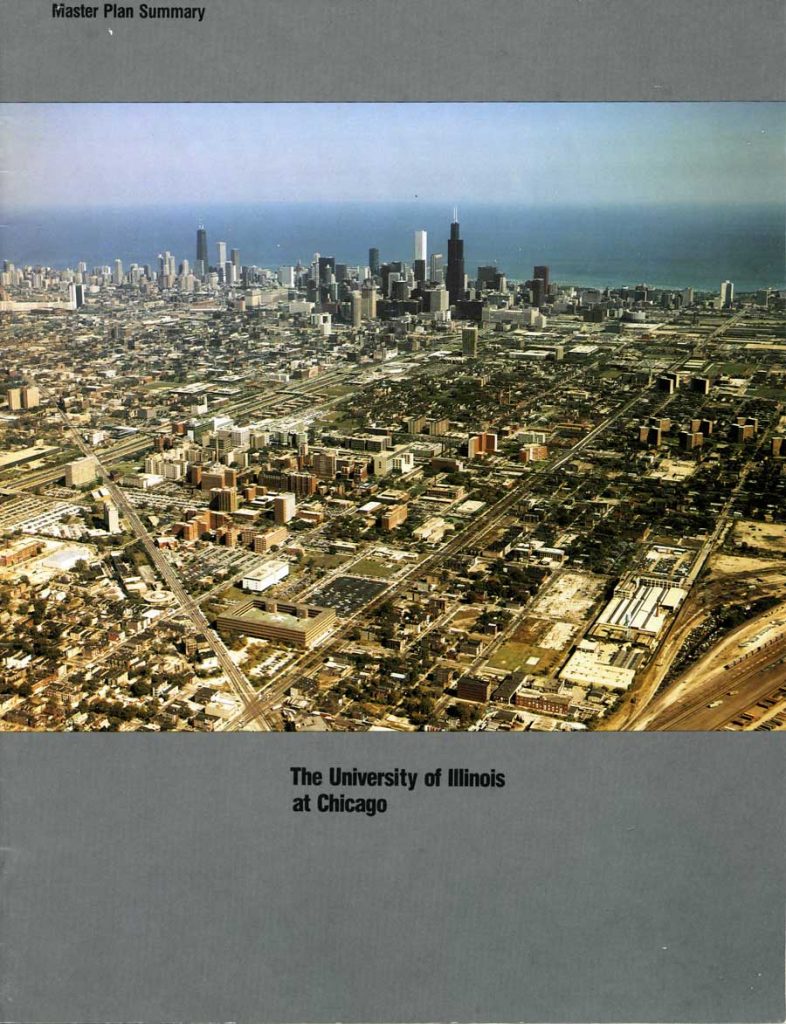
In 1990, the University of Illinois at Chicago published a Master Plan that was “… the first to give substantial emphasis to the interface between the campus and the surrounding community context.” Existing users cited as providing “… a special opportunity for accommodating future campus expansion” included the Maxwell Street Market and Halsted Street merchants.
1993
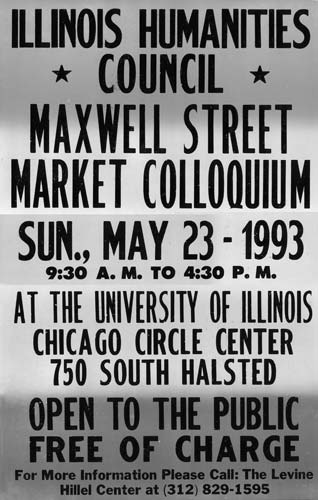
Activists organize a one-day colloquium with four panels of experts to recognize the significance of the Maxwell Street Market, and choose the UIC Circle Center auditorium as the venue.
1994
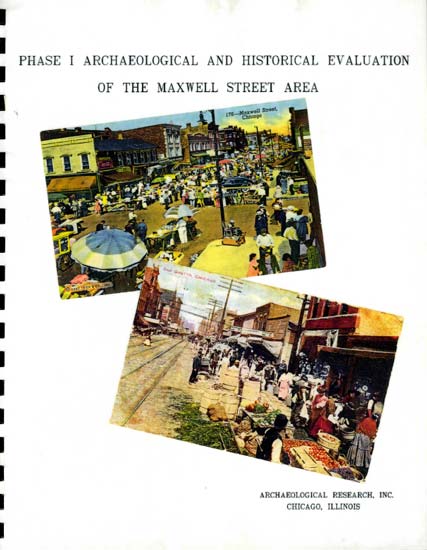
Phase 1 Archeological and Historical Evaluation of the Maxwell Street Area (1994) is completed by Archaeological Research, Inc., to fulfill legal requirements under the 1966 National Historic Preservation Act and Section 4 of the Illinois State Agency Historic Resource Protection Act.
1994
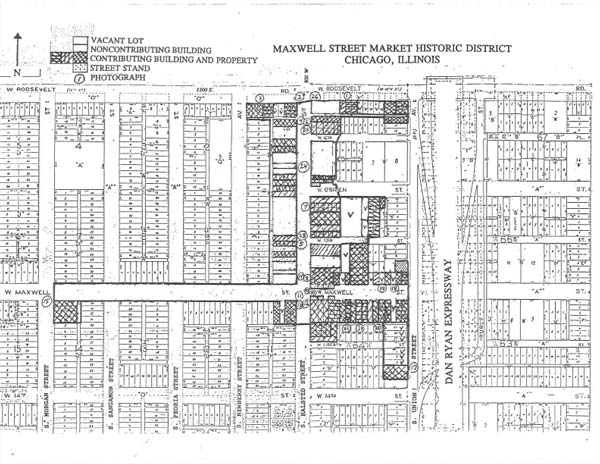
A nomination application for a Maxwell Street Market Historic District is submitted to the National Register of Historic Places for 60 contributing buildings in the Maxwell Street neighborhood. It has unanimous support from the Illinois Historic Sites Advisory Council at the state level, but lacked approval from the State Historic Preservation Officer and the Keeper did not approve the application at the federal level.
1994
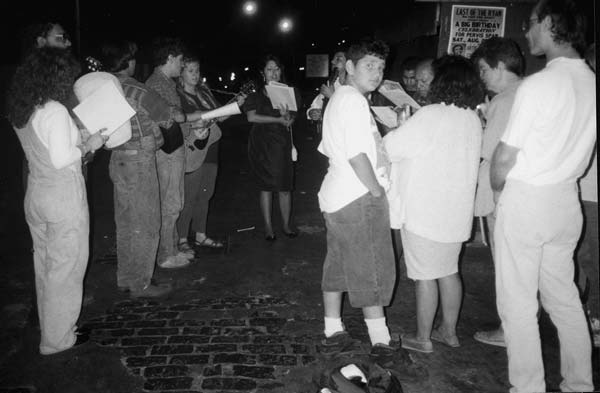
The Maxwell Street Market is closed at its historic site by the City of Chicago and relocated to Canal Street. The Vendors Association held an evening novena for the intercession of the Virgin Mary for nine nights in August 1994, praying to save the market, as it “accepts all, serves all, and helps us learn to get along with our brothers and sisters…that the people of the market not be split apart, that even the poorest can work and be among us.”
1994
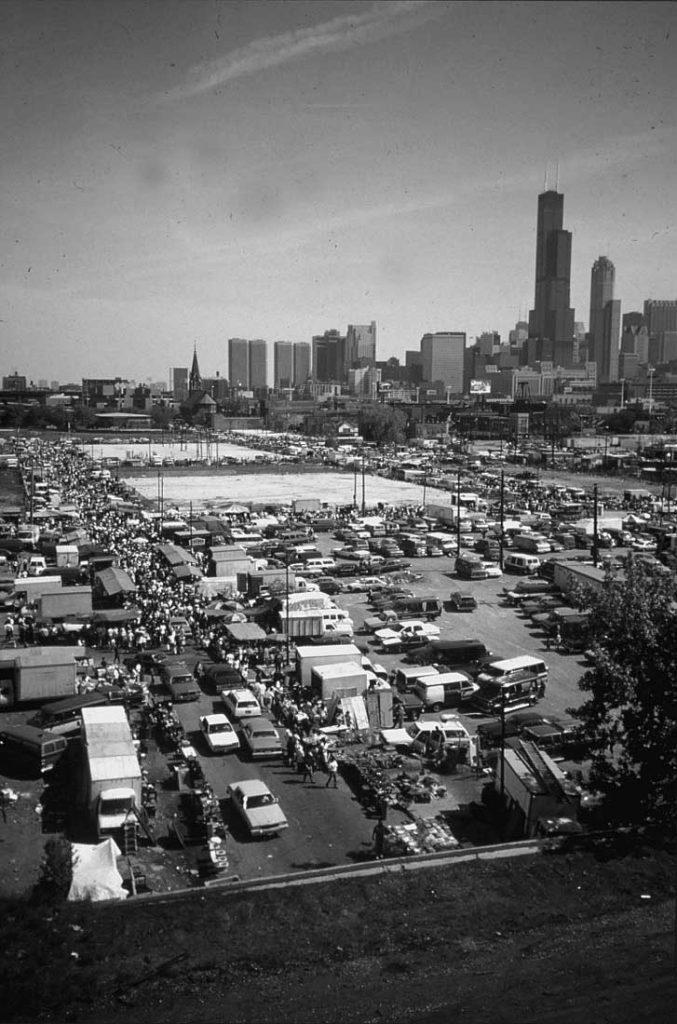
The Maxwell Street Market, with Chicago’s skyline in the background, as it looked from above at the time of its closure at its historic site.
1994
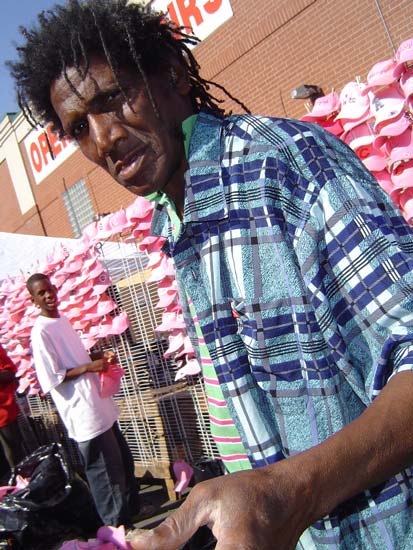
The New Maxwell Street Market opens on Canal Street, extending south from Roosevelt Rd. to 16th Street, several blocks east of the old Market area.
1994
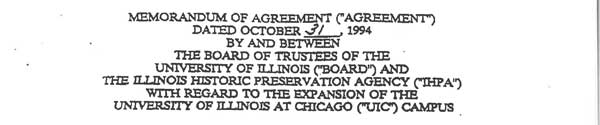
A Memorandum of Agreement (MOA) between the University of Illinois Board of Trustees mandates actions that include the creation of an Interpretive Exhibit and documentation of extant buildings according to Level 1 HABS/HAER standards, prior to demolition.
1995
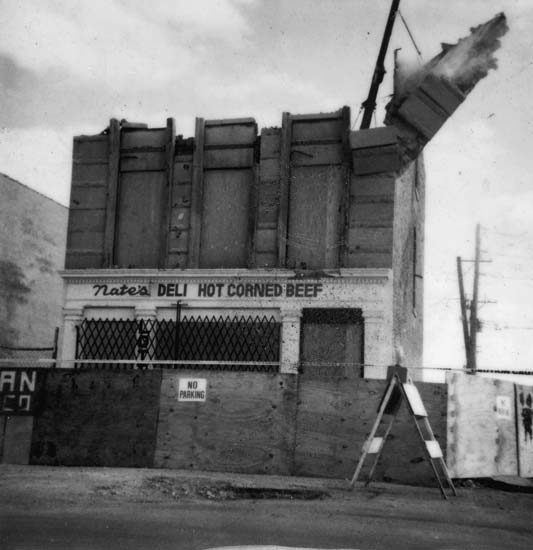
Nate Duncan, proprietor of the iconic Nate’s Deli on Maxwell Street, sells his building to the University of Illinois at Chicago, completing the removal of the built fabric on the southwest corner of Maxwell Street and Halsted. The University demolishes the structure and builds the Marie Robinson Residence Hall there for their south campus expansion.
1996
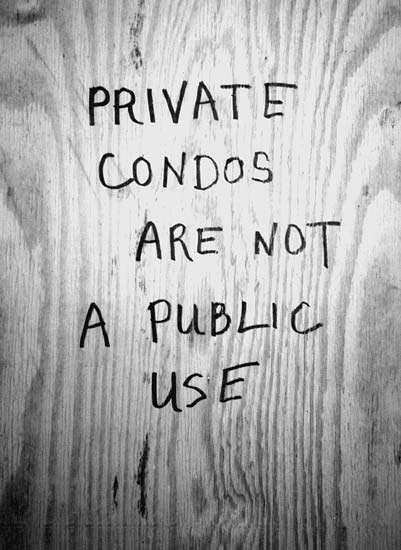
The Illinois General Assembly granted the University of Illinois at Chicago eminent domain power in the Maxwell Street area for their south campus expansion. This sign attacks UIC’s claim that the land appropriated is for a public use. The development of private residences for profit, and favoring one set of retailers over another was inconsistent with a public purpose. The Maxwell Street Museum Project is founded by preservationists to collect historic artifacts and architectural remnants from Maxwell Street as buildings are demolished. The organization became the Maxwell Street Historic Preservation Coalition, now renamed the Maxwell Street Foundation.
1996
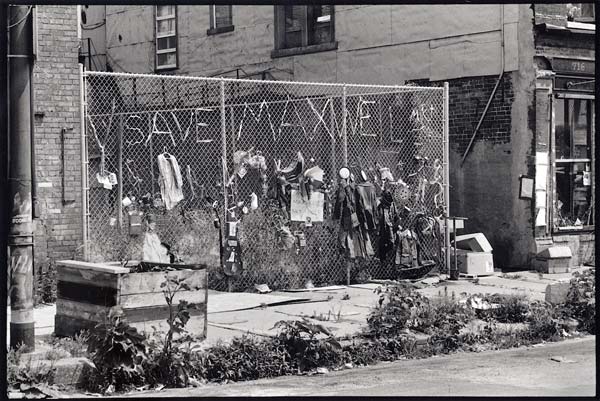
The Art Fence was created on Maxwell Street as a homage for its preservation.
1997
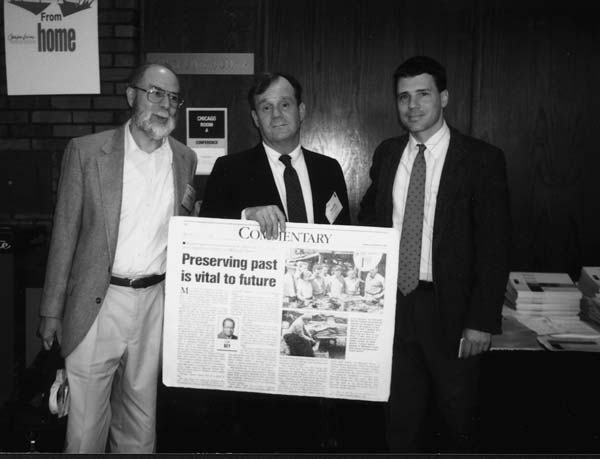
In 1997 through 1998, members of the Maxwell Street Historic Preservation Coalition assisted in a negotiated compromise between the city, university, and developers to preserve buildings in the planned redevelopment.
1998
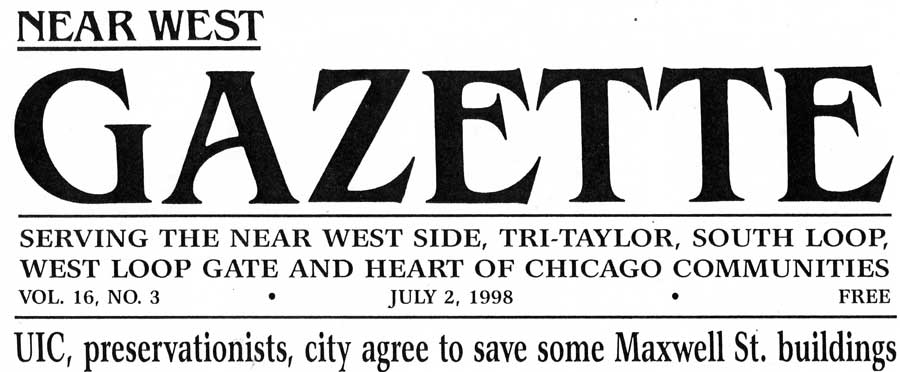
A press report announces an initial plan by the university to preserve 36 buildings, due to preservationist intervention.
1998
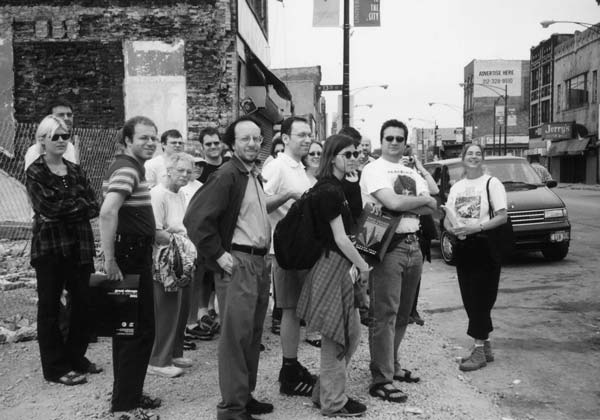
A Historic Maxwell Street Walking Tour is developed to bring visibility to the changing neighborhood. The tour was given until 2002, when sidewalks became impassable due to demolition and construction. The tour was modified to reflect the new redevelopment, and continues to be offered today.
1998
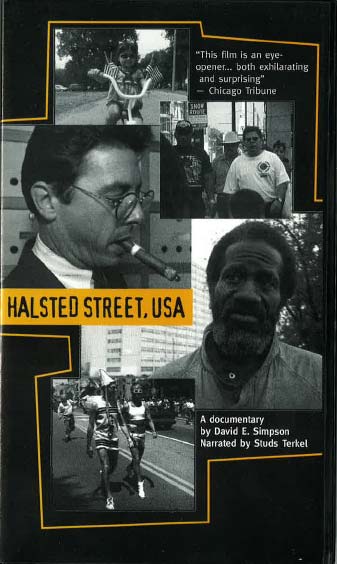
A film documenting the entire length of Halsted Street, a state route, includes the intersection at Maxwell Street.
1998
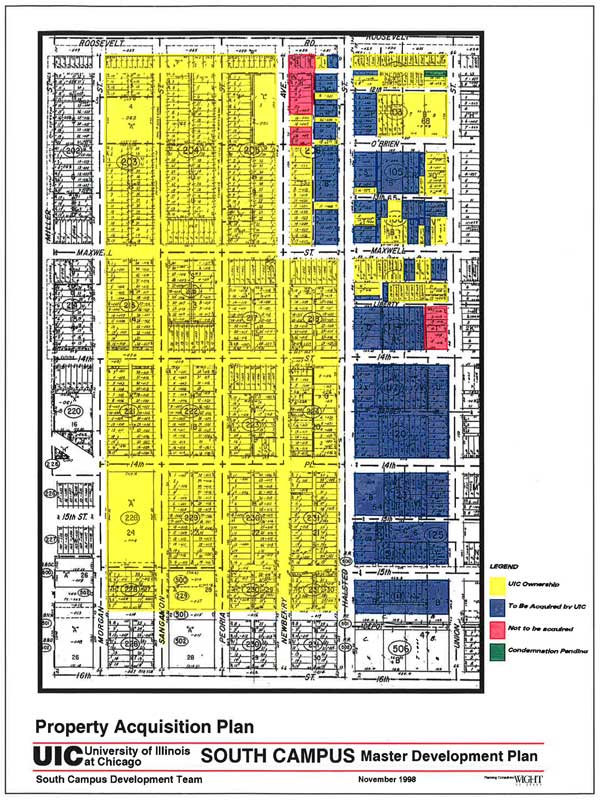
A 1998 South Campus Development Master Plan shows UIC ownership on Maxwell Street from Union Ave. to Morgan St., with the exception of eight lots shown “to be acquired by UIC.” A stop to demolition to one of these properties at 1311-1313 S. Halsted, damaged by a neighboring fire, was successfully won in court by the Maxwell Street Historic Preservation Coalition and the facade is intact today on new construction.
1999
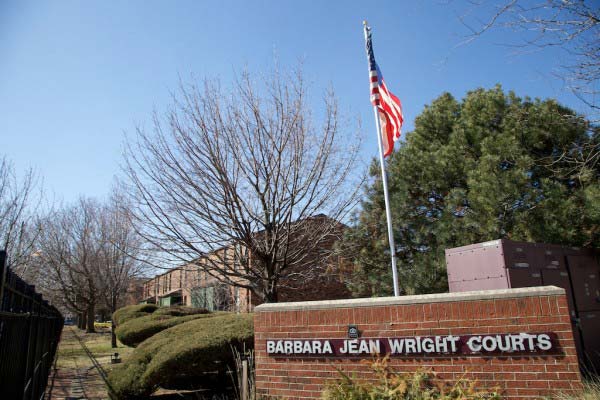
The Chicago Community Development Corporation purchases a large site for development on Maxwell Street at Morgan to build the Low Income Housing project, Barbara Jean Wright Court apartments.
2000
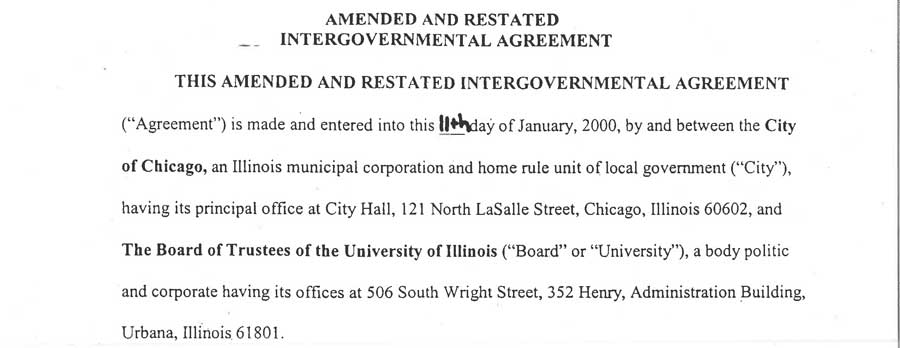
The Amended and Restated Intergovernmental Agreement of January 2000 between the City of Chicago the Board of Trustees of the University of Illinois preserved eight buildings and one façade for adaptive re-use, and introduced the dismantling and reinstallation of twelve historic facades in the redevelopment plan.
2000
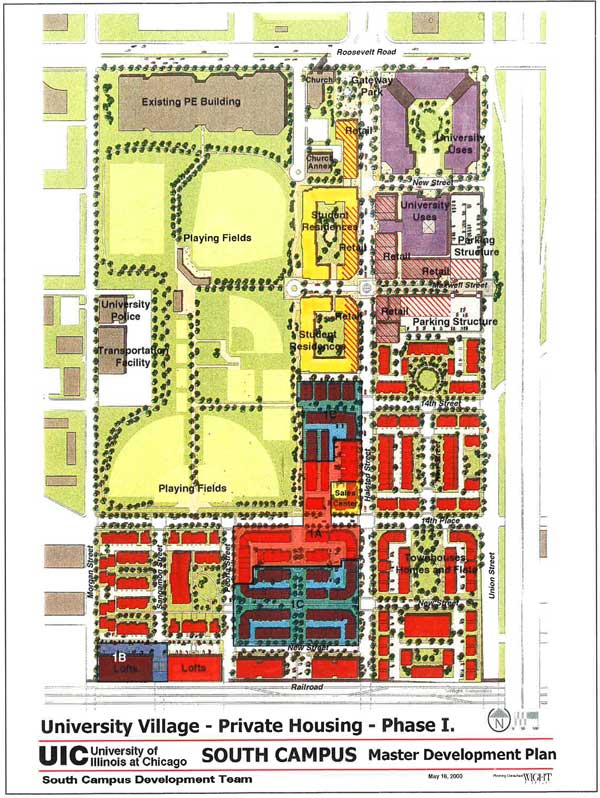
UIC publishes a mapped plan for the redevelopment of the Maxwell Street area.
2000
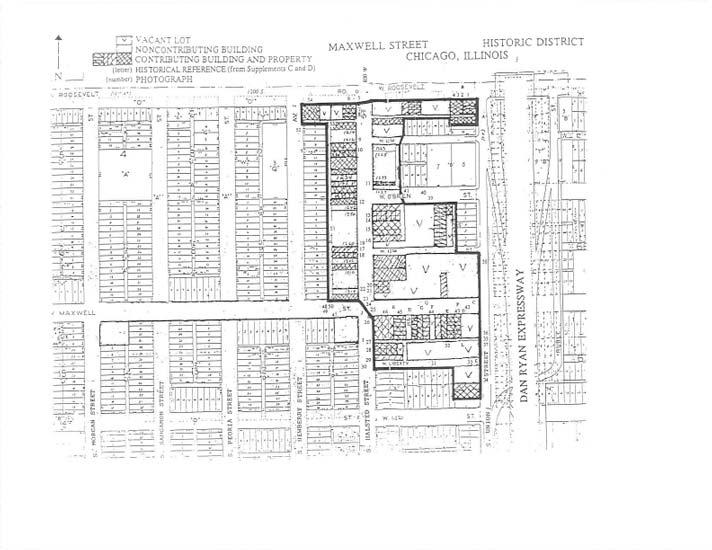
A second and final nomination application for a Maxwell Street Historic District is submitted to the National Register of Historic Places for 43 contributing buildings in the Maxwell Street neighborhood. The application was supported by the Illinois Historic Sites Advisory Council but not by the Illinois Historic Preservation Agency because so much of the built fabric of the original Market area had been removed, including the Market. The Maxwell Street Historic Preservation Coalition lost its court case to prevent further demolition while the district was under consideration for eligibility, and the application was not forwarded to the Keeper by the State Historic Preservation Officer.
2000
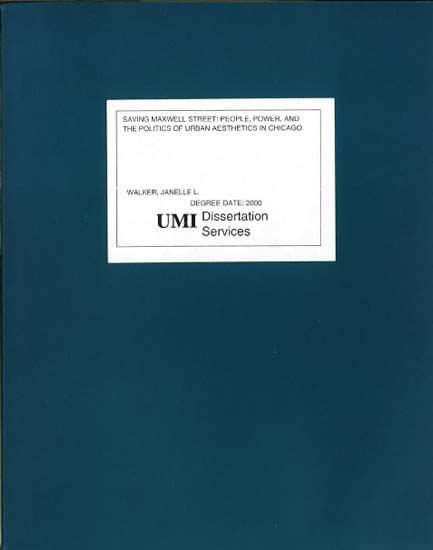
Janelle Walker submits her dissertation entitled, “Saving Maxwell Street: People, Power, and the Politics of Urban Aesthetics in Chicago”, that is a third scholarly work on Maxwell Street.
2002
The last stand of contiguous buildings on Maxwell Street before their demolition in 2002 (with the exception of 733 and 749 W. Maxwell on the west end of the block which were part of the 2000 IGA for rehabilitation).
2002
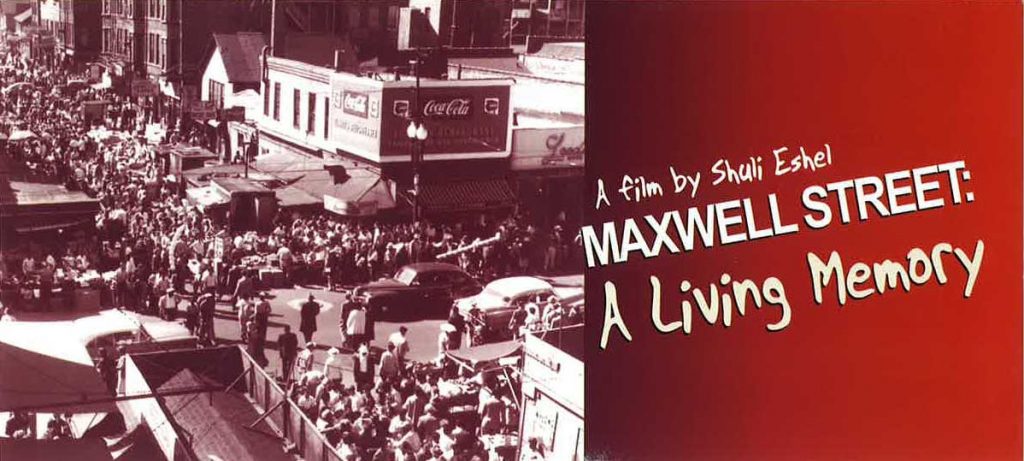
“Maxwell Street: A Living Memory, the Jewish Experience in Chicago” historical documentary is produced and directed by filmmaker Shuli Eshel with Executive Producer Elliot Zashin, an officer of the Maxwell St. Foundation.
2002
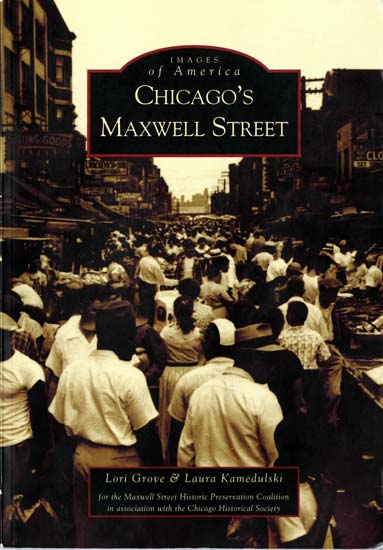
“Chicago’s Maxwell Street” is coauthored by Lori Grove and Laura Kamedulski of the Maxwell Street Foundation and published by Arcadia Publishing, Inc., chronicling Maxwell Street history.
2004
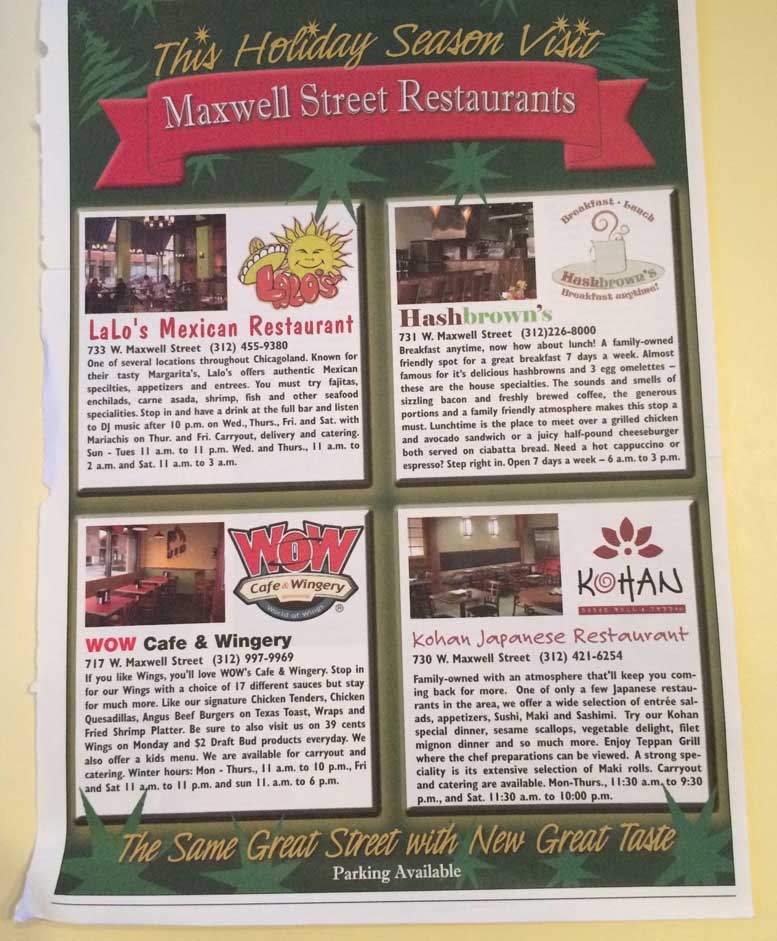
New restaurants and shops on the redeveloped streets of Maxwell and Halsted Streets are well-positioned for holiday advertising in the retail area renamed University Village Marketplace.
2004
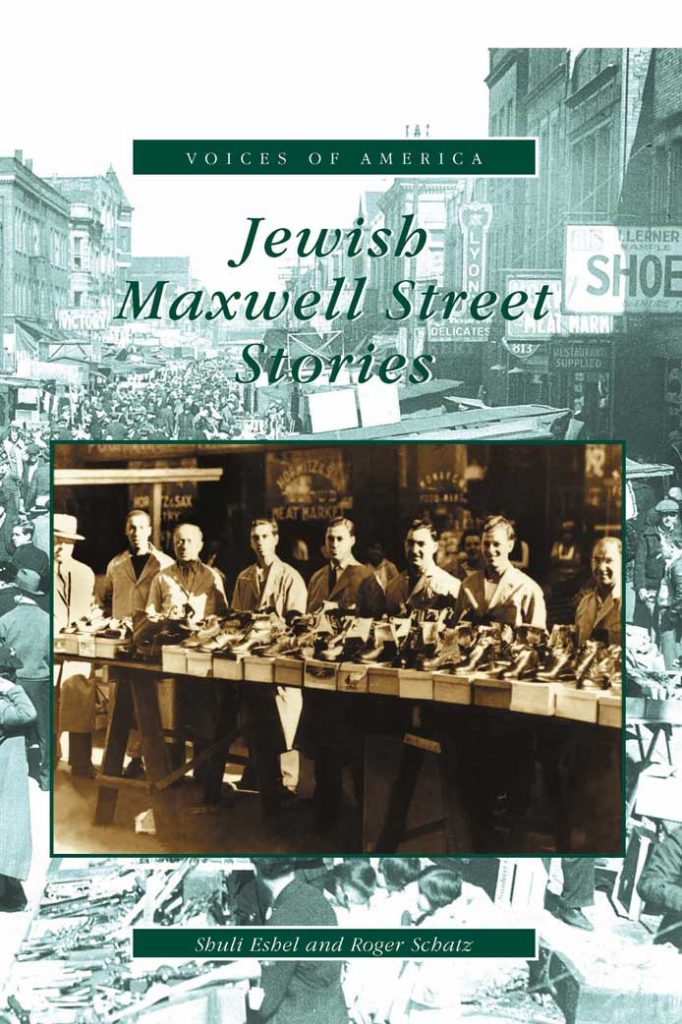
“Jewish Maxwell Street Stories” is published by Arcadia Publishing, Inc., written by Shuli Eshel and Roger Schatz to illustrate the Jewish presence that prevailed on Maxwell Street throughout its history.
2005
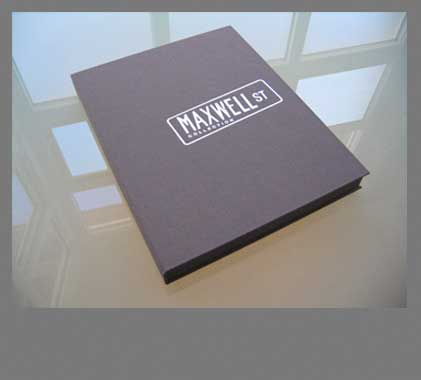
The Maxwell Street Collection portfolio is published by the Maxwell Street Foundation showcasing a limited copy edition of photographs taken in the Maxwell Street area by 11 Chicago photographers, spanning the years from 1936 to 2000, with an introduction by the late Pulitzer Prize-winner Studs Terkel.
2005
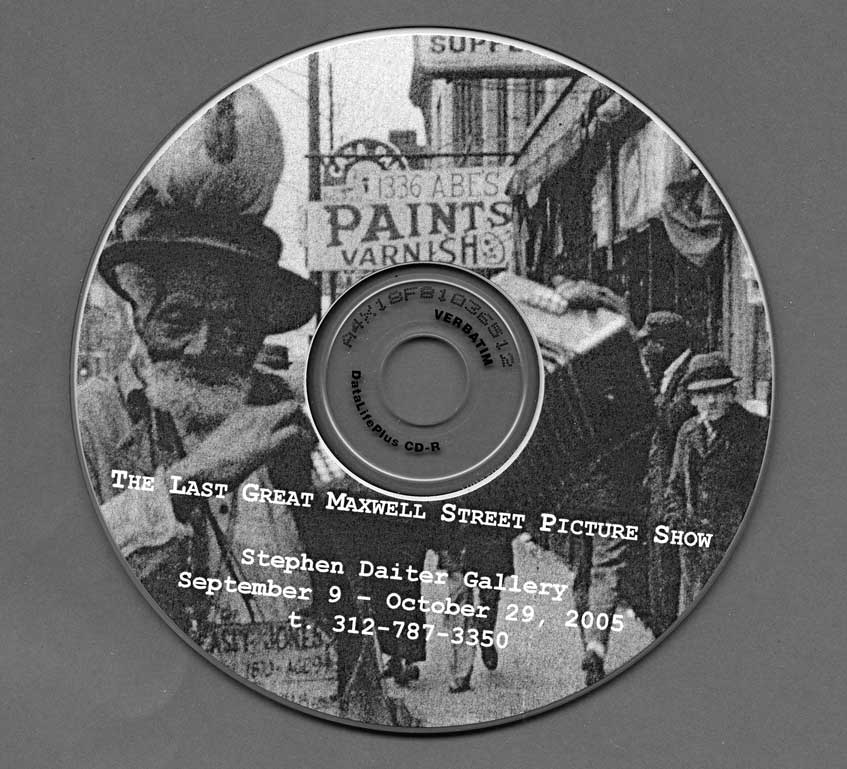
The Last Great Maxwell Street Picture Show is presented at Stephen Daiter Gallery, Chicago, starring a host of Chicago’s favorite photographers and their images from over a half century of artistic response to the city’s longest standing open-air market on Maxwell Street.
2006
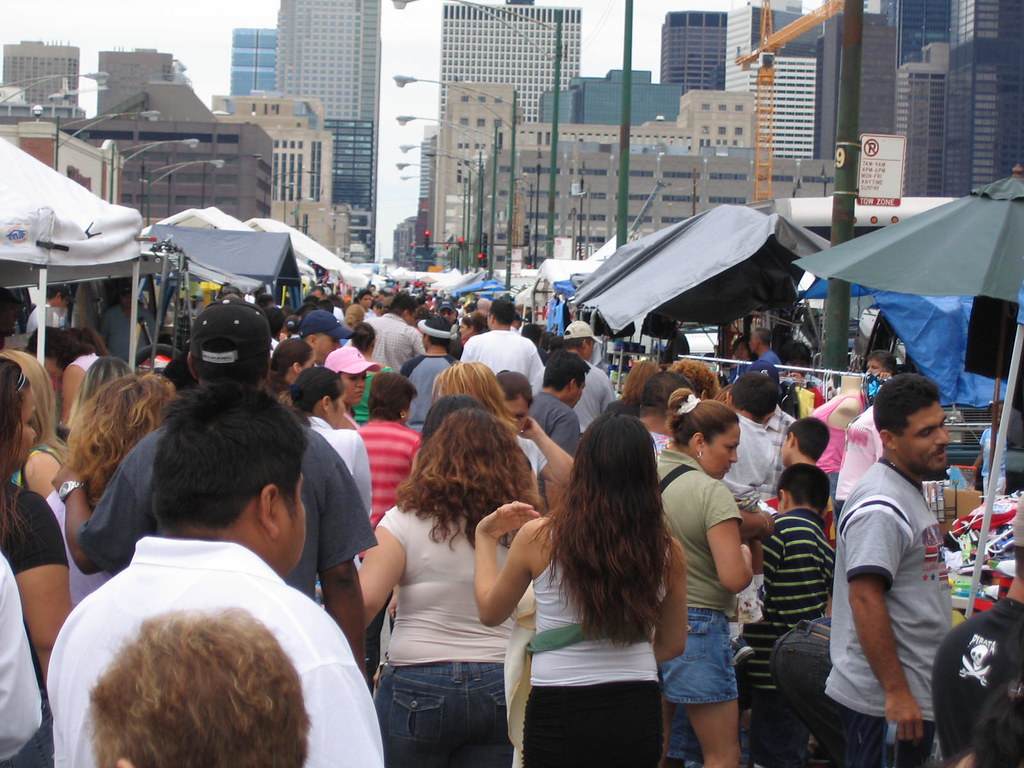
After the Market was moved from its historic location in 2004, the Market along Canal Street no longer had the anchors of the storefront buildings and permanent street stands, but the shopping and street food was still a draw on Sundays. (photo by Steve Balkin c. 2005)
2007
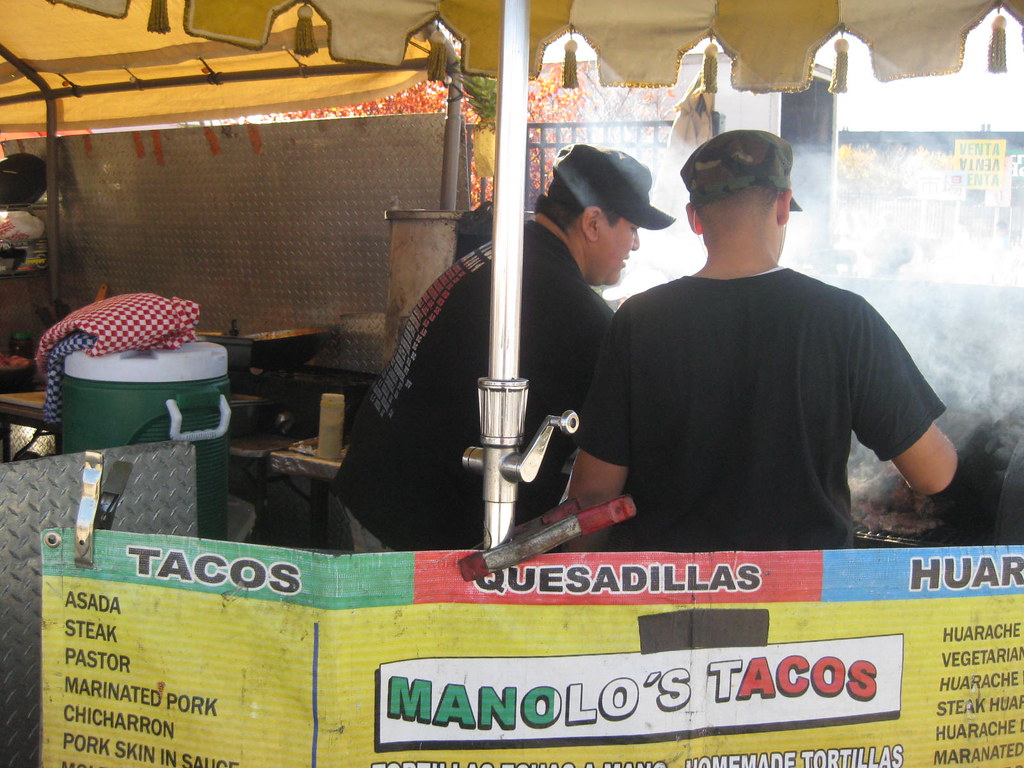
The city of Chicago moved the Sunday Maxwell Street Market again in 2007 from Canal Street to Desplaines Avenue north of Roosevelt Road. The Market was known for great Mexican and Latin street food in this era. (photo by Steve Balkin, 2017)
2008
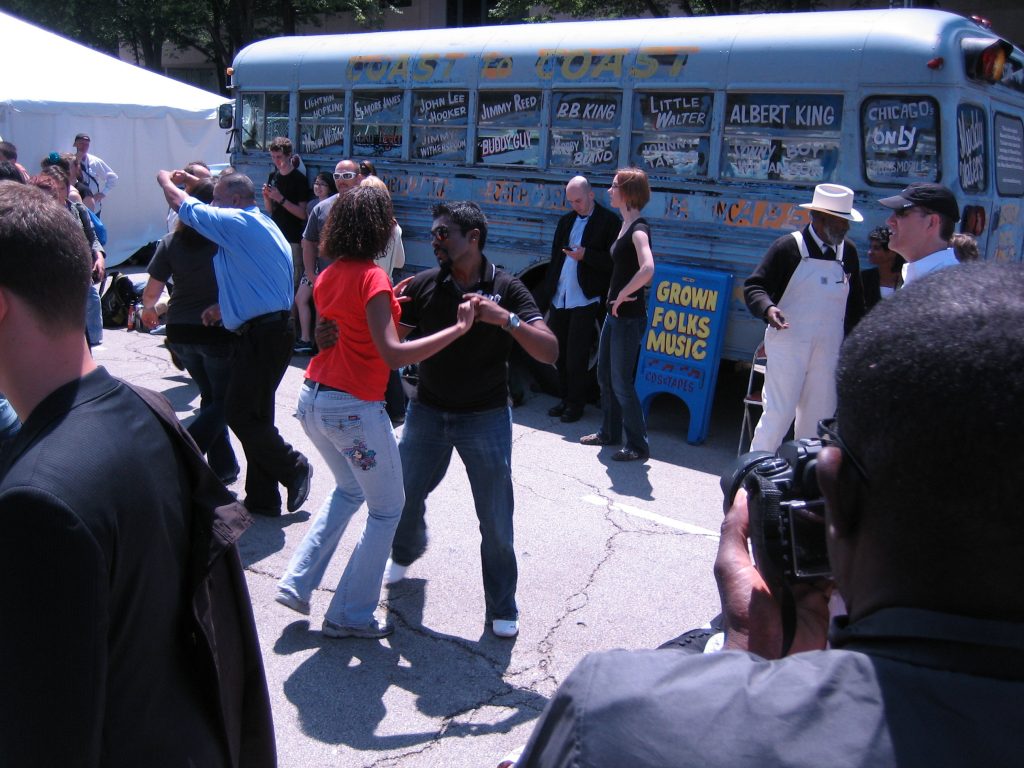
The Maxwell Street Foundation brought the Maxwell Street Blues Bus as an attraction to Chicago’s Bluesfest for several years. The Blues Bus had been a rolling record shop and a symbol of how “Down Home Music” at the Market broke down differences between people. The Blues Bus was created by John & Marie Johnson, Market vendors who sold Blues and other music from the 1972 Chevrolet Bluebird school bus painted blue with Blues musicians’ names on the windows. (photo by Laura Kamedulski, 2008)
2010
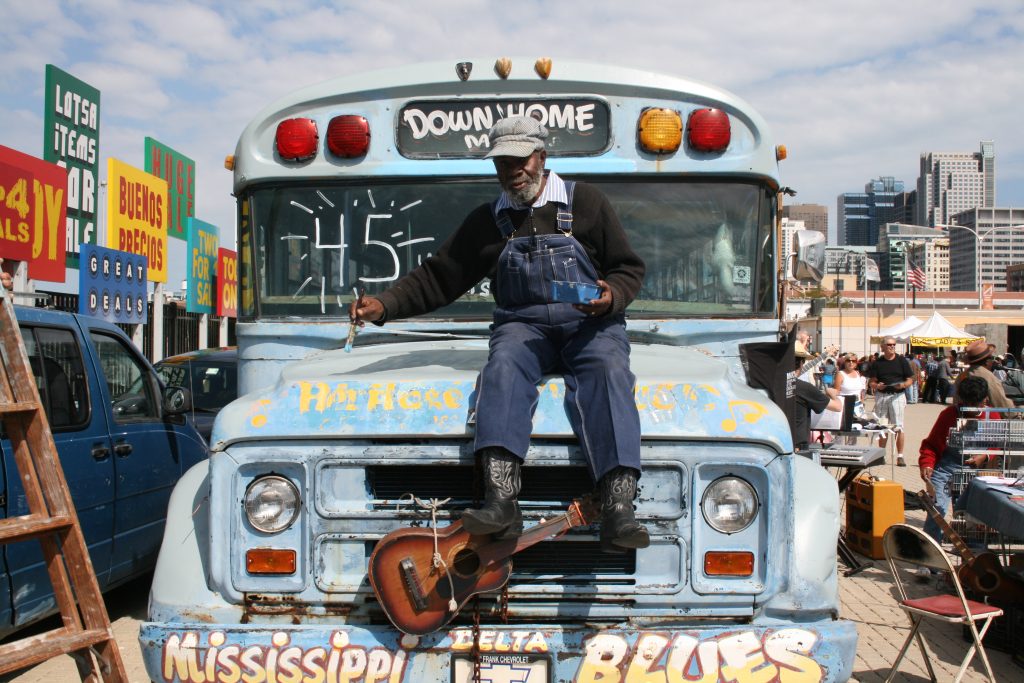
The Maxwell Street Blues Bus appeared as an attraction at the Maxwell Street Market due to its historic connection to the “old” Market. John & Marie Johnson, the bus’s creators who sold music recordings from the Bus at the Market for decades, felt that music provided an uplift to the spirit of people who were oppressed and depressed by discrimination, segregation, or poverty. (John Johnson repainting the Blues Bus, photo by Laura Kamedulski, 2010)
2012
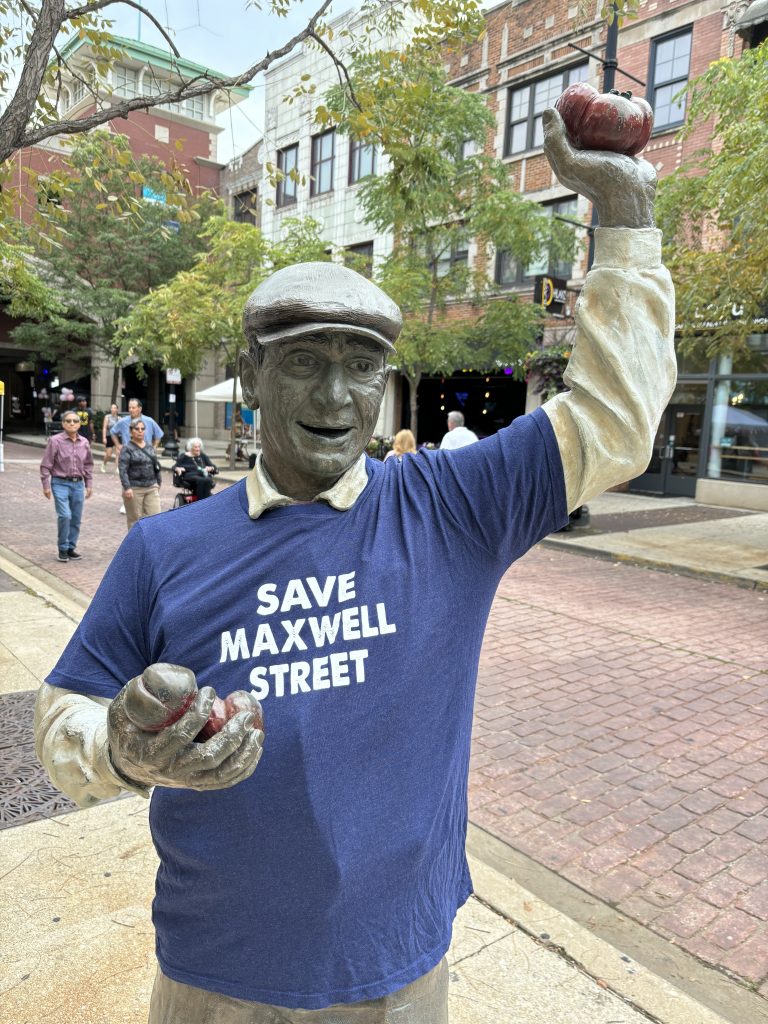
A decade after the UIC redevelopment of the Maxwell and Halsted Street area, the rehabilitated historic buildings and facades along Maxwell and Halsted Streets echoed the past, even though all of the facades (except two reinstalled at 729 and 727 W. Maxwell) were relocated on Maxwell Street at different locations from their original sites. Statues and interpretive plaques on the one remaining full block of Maxwell Street pay tribute to former shoppers, vendors, and performers like Daddy Stovepipe and Chicken Man Casey Jones. (Photo by Laura Kamedulski)
2024
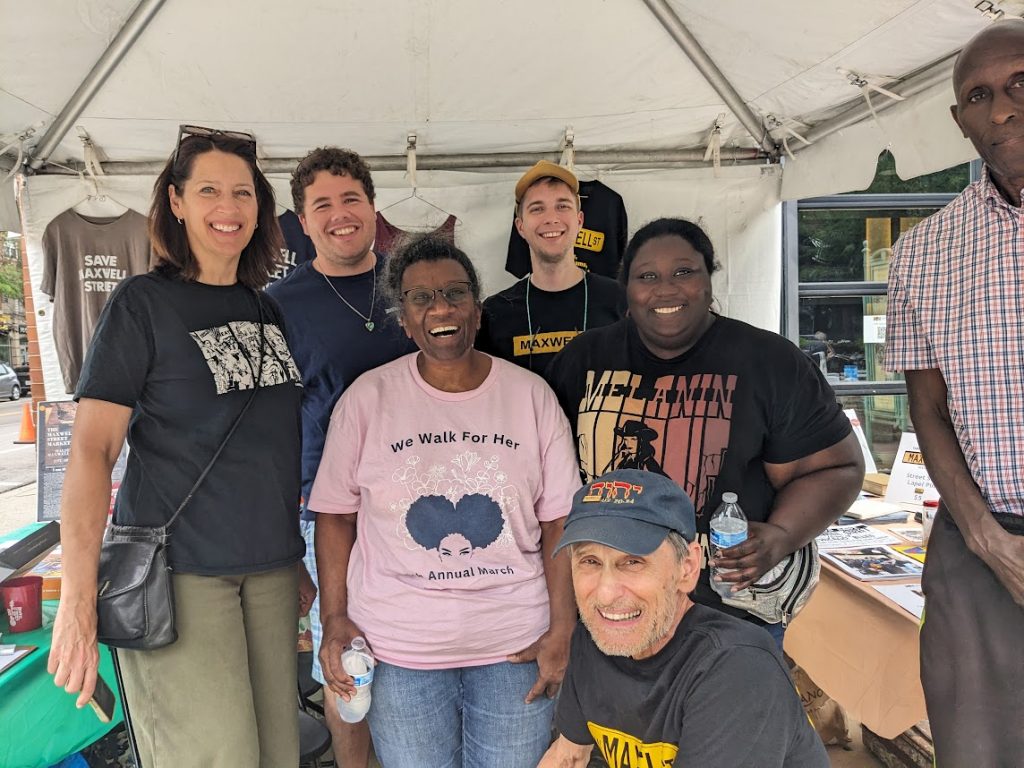
The city of Chicago moved the Maxwell Street Market back to one block of its historic location at Maxwell and Halsted Streets in 2024. The Market happens one Sunday a month, from May through October. People enjoy shopping, food from the restaurants, and music and cultural programming. The Market is operated by the city’s Department of Cultural Affairs and Special Events (DCASE). The Maxwell Street Foundation has a stand at the Market and gives historic tours of the area on Market days. (Members of the Bronzeville Historical Society visiting with Maxwell Street Foundation board members at their booth, photo by Laura Kamedulski, 2024)
2025
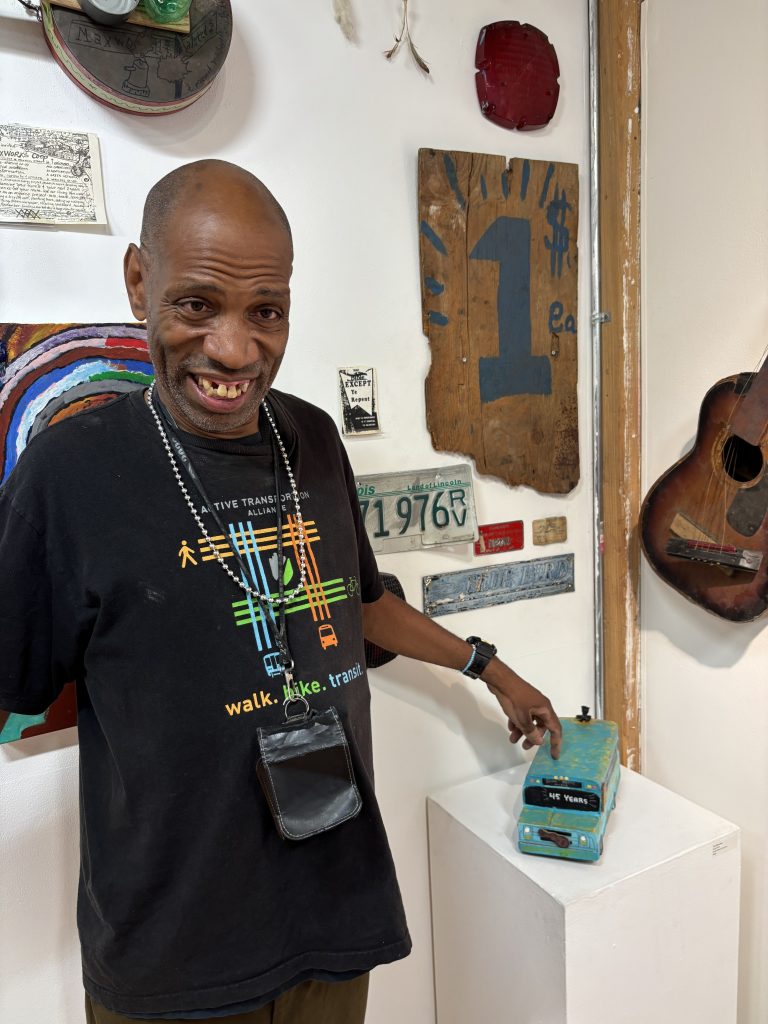
The Maxwell Street Foundation collaborated with Project Onward, a collective of neurodivergent artists, to create original art about the Maxwell Street Market by nine artists, along with a curated selection of the Maxwell Street Foundation’s historic artifacts for the Poor Man’s Paradise exhibition, shown at the Project Onward gallery in the Bridgeport Arts Center in Chicago from August-October 2025. (Artist Ricky Willis with his model of the Blues Bus, surrounded by historic artifacts, photo by Laura Kamedulski, 2025)